

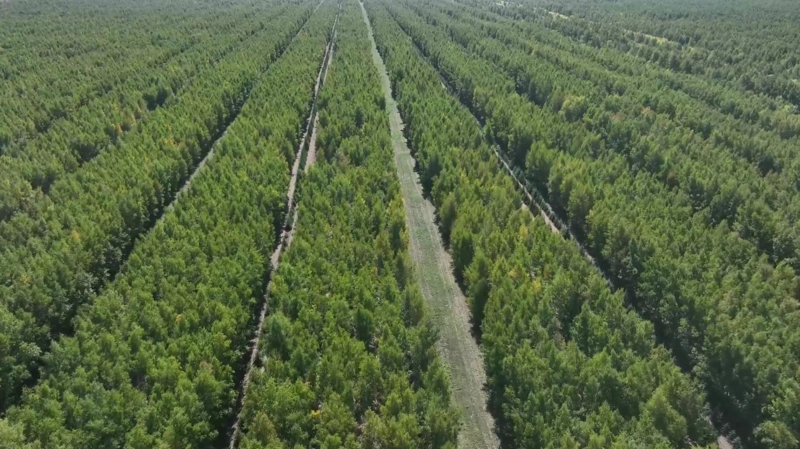
Currently, the green belt around the capital covers 16,000 hectares, home to approximately 15 million trees. A Kazinform correspondent investigates whether this experimental project has succeeded in transforming into a true forest with its own ecosystem.
How the Green Belt was created
This project began after the capital was relocated from Almaty to Akmola. The creation of a green belt around the capital to mitigate adverse climatic conditions and create a comfortable living and recreational environment for the city’s residents was resolved by a resolution of the State Commission of the Republic of Kazakhstan on the relocation of the capital in January 1996. From 1998 to 2004, forests were planted on an area of 14,827 hectares.

The location of the plantings was dictated by the difficulty of accurately predicting the survival rate, condition, and quality of future plantings due to soil conditions, that is, the presence of patches of salt marshes and solonetz in forest-suitable areas.
According to experts, the plantings were initially formed using a layered method to conserve soil moisture. As Ardak Khasenov, chief agronomist at Astana Ormany LLC, noted, the development of the green belt is roughly divided into two stages. During the second stage—from 2012 to 2024—the forests were compacted and approximately 4.9 million more trees were planted.
A quarter of a century ago, few believed that a true forest could grow in the steppe. But Astana’s green belt has become one of the largest afforestation projects in the world. Currently, 36 tree species, adapted to local climate conditions, grow here.

“Currently, 9.6 million trees and 1.8 million shrubs grow in this area. Both coniferous and deciduous trees are thriving on the site, and the plantings continue to develop,” said Ardak Khasenov.
Impact on climate and ecosystem development
According to experts, the creation of the green belt has already impacted the capital’s climate. The number of dust storms has decreased almost threefold, as have the number of snowstorms and foggy days. At the same time, the number of wet periods has increased, making the climate more stable.
Particular attention is being paid to the development of recreational infrastructure. Bicycle and equestrian trails have already been created within the green belt, used by residents and visitors to the capital.

“A 26-kilometer-long bicycle path was created along a section of the southwestern part. Later, a 13.2-kilometer-long equestrian trail was added. Now, spruce, pine, and birch trees grow here, forming a full-fledged forest,” noted Ardak Khasenov.
Territorial expansion and long-term plans
In the future, the number of trees is planned to increase further. However, before this, specialists will conduct long-term scientific research on soil reclamation, as the new areas are characterized by solonetzic and saline soils. In the coming years, experimental research sites will be established in collaboration with specialized institutes. Only after the most effective methods are selected will large-scale afforestation begin.

“First, scientific research and testing of various land reclamation methods will be conducted. Then, the most effective option will be selected, and only then will the development of a reforestation project begin,” the chief agronomist said.
According to experts, work on expanding the green belt will begin within a few years after the scientific stage is completed.
Ecological effect and fauna observation
Over the years, a veritable forest has formed here. Hares, foxes, corsac foxes, roe deer, and even elk have already been recorded appearing in the green belt. Bird diversity is also increasing.
“First, hares appeared on their own, and their numbers are currently growing exponentially. In natural forests, this is controlled by predators like foxes and corsac foxes. Incidentally, we have them too, but not in large numbers yet. Over time, we hope the predator population will increase; this is crucial for the development of a self-regulating ecosystem,” said Ardak Khasenov.

The capital’s green belt is under 24-hour protection from foresters and firefighters. Among them is Kanatbek Sametov, who has been working here for nine years. He says working in the forest plantations requires constant attention and maintenance. But at the same time, it provides a sense of peace, improves health, and allows one to feel part of a greater cause—conservation.

“I like this job—it’s outdoors, after all. It’s good for my health: we move a lot, walk, and the air is clean. It’s both work and pleasure,” he noted.

The Astana Green Belt is a large-scale environmental project that, over the course of 25 years, has evolved from experimental plantings into a fully-fledged forest. Since 2025, the area has been granted the special status of a forest park zone of Astana.

You can read about how the road and path network in the green belt around the capital was created here .
Google machine translated