

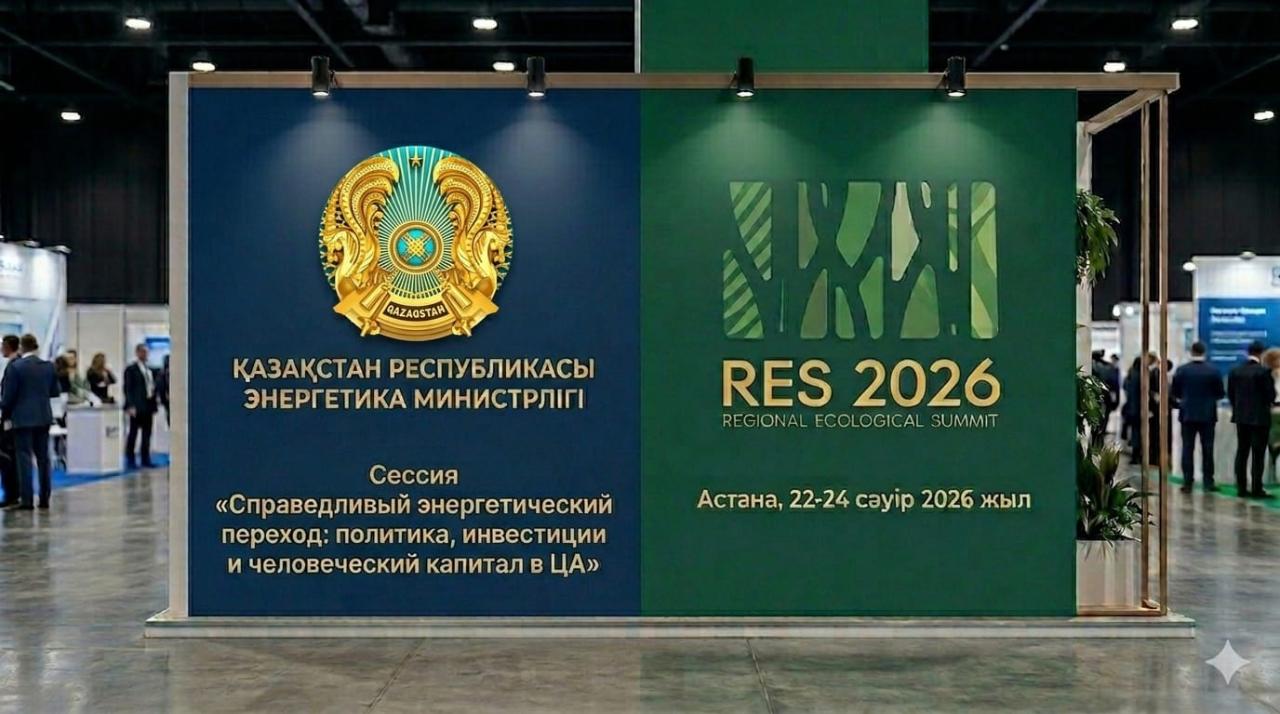
QAZAQ GREEN. In two weeks, Astana will host the Regional Ecological Summit, with a key session organized by the Ministry of Energy titled “Just Energy Transition: Policy, Investment and Human Capital in Central Asia.”
A steady shift toward renewable energy remains central to strengthening energy security and achieving carbon neutrality.
Kazakhstan’s renewable sector is already showing strong momentum. The country operates 162 facilities with a combined capacity of 3.5 GW, and by the end of 2025, renewables accounted for 7% of the national energy mix. Over the past year, nine new plants with a total capacity of 503 MW were commissioned. Electricity generation from renewable sources reached 8.6 billion kWh, exceeding projections by 19.4%.
In 2026, the Ministry plans to increase clean energy output to 8.8 billion kWh. The roadmap includes launching 10 new projects with a total capacity of 245 MW, including four wind farms, five solar plants, and one hydropower facility. Key policy steps include adopting a Law on Alternative Energy and updating the Hydrogen Energy Development Concept through 2040. Competitive auctions remain the main tool for attracting investment, with a total planned volume of 6.7 GW for 2024–2027.
International partnerships are playing a growing role in developing large-scale wind projects equipped with energy storage systems. In Zhambyl region, construction has begun on a 1 GW wind farm by TotalEnergies, while a similar 1 GW project is underway in Pavlodar region in cooperation with State Power Investment Corporation.
Global renewable energy leader Masdar is also launching major projects in Kazakhstan. In the long term, more than 8 GW of renewable capacity is expected to be commissioned by 2035, strengthening the resilience of the national power system and diversifying the energy mix.
The Regional Ecological Summit (RES 2026) will bring together Central Asian countries and international partners to address key Ecological challenges, including climate change, water resource degradation, and sustainable resource management. The event will take place in Astana on April 22–24, 2026, and is expected to gather around 1,500 participants from government, business, international organizations, and academia.
The initiative to hold RES 2026 in partnership with the United Nations was announced by President Kassym-Jomart Tokayev during the 78th session of the UN General Assembly in 2023.
More information: https://res2026.kz/
https://qazaqgreen.com/en/news/kazakhstan/3498/