

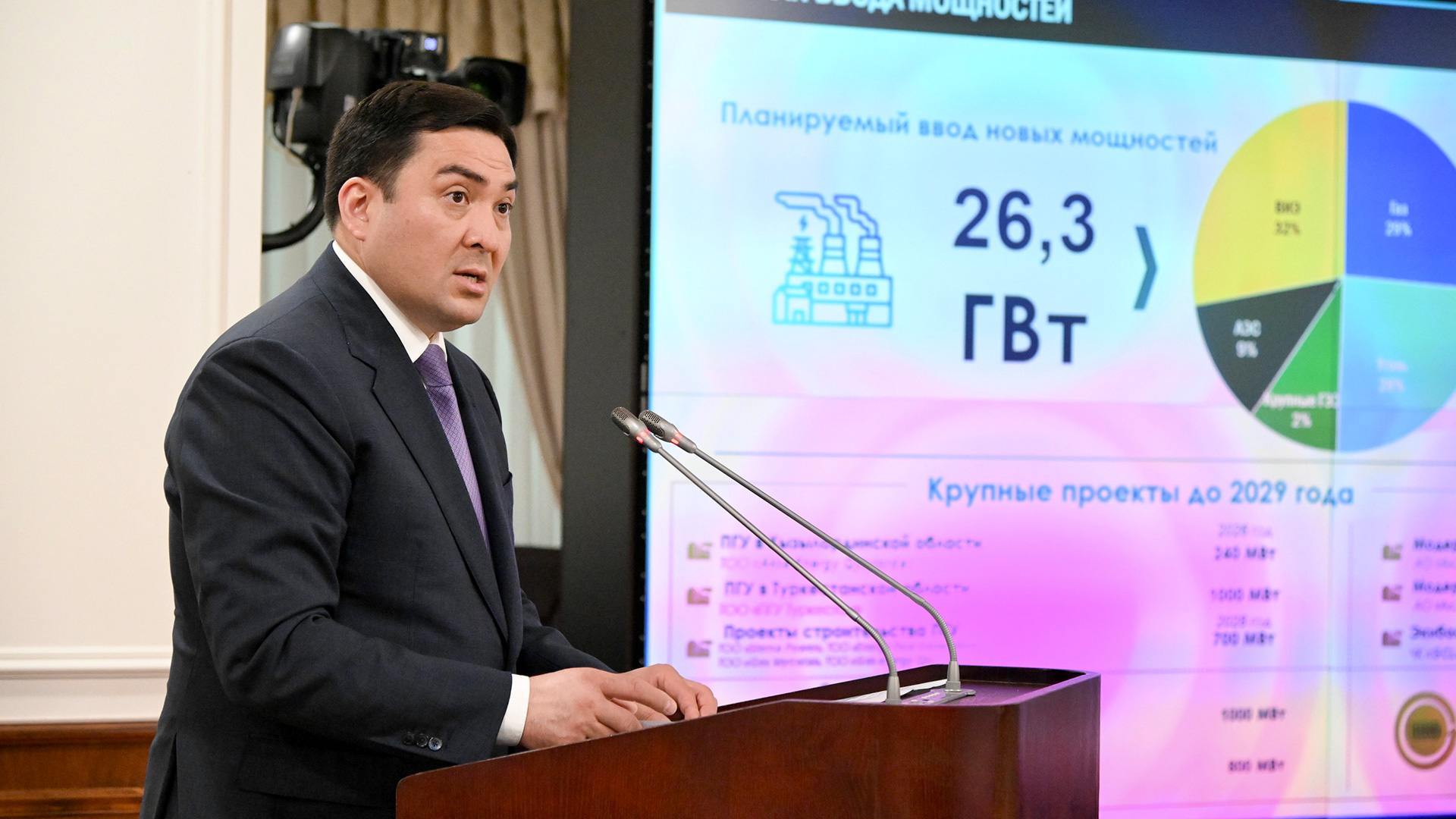
 At a government meeting chaired by Prime Minister Olzhas Bektenov, the implementation of the Head of State’s instructions was discussed in light of the entry into force of the new Constitution of the Republic of Kazakhstan. Energy Minister Yerlan Akkenzhenov delivered a report on the development of fuel and energy sectors, generation modernization, and the pace of regional gasification.
According to him, as part of implementing the President’s strategic objectives, the Ministry is systematically working to increase the country’s energy potential. Currently, Kazakhstan’s energy system, including newly commissioned facilities, includes 254 energy sources, 172 of which are renewable energy sources. The total installed capacity of all facilities is 27.1 GW. The majority of the generation mix comes from traditional sources: coal-fired power plants provide 13.7 GW, gas-fired power plants 7.1 GW, and large hydroelectric power plants 2.5 GW. The total capacity of renewable energy facilities has reached 3.8 GW.
Last year, electricity production in the republic reached a historic high, reaching 123.1 billion kWh, while consumption stood at 124.6 billion kWh. This year, the planned targets are expected to be met and even exceeded. According to the agency’s forecasts, electricity generation will increase to 126.5 billion kWh. Overall, a steady trend toward narrowing the gap between electricity production and consumption has emerged across the country.
“As part of the Energy Sector Development Plan through 2035, work is actively underway to commission additional generating capacity totaling over 26.3 GW. By 2029, 13.3 GW of new capacity will be commissioned, of which 7.4 GW will be baseload generation and 5.9 GW will be renewable energy facilities. Of this total, 12.56 GW will be entirely new generating facilities, and 0.74 GW will be used to replace existing capacity. This will allow us to fully cover the economy’s overall electricity needs as early as 2027, and subsequently create a sustainable surplus,” emphasized Yerlan Akkenzhenov.
Building a capacity reserve by 2029 will fully meet the growing needs of the population and the real sector, including the creation of energy-intensive artificial intelligence infrastructure and the deployment of large data centers. The need for new facilities is determined by the agency’s systematic calculations, taking into account projected consumption growth. Based on continuous monitoring and analytical assessment of current economic needs, plans are updated in a timely manner.
In parallel, the Ministry is implementing a National Project for the Development of Coal-Fired Generation Based on Clean Coal Technologies in Compliance with All Environmental Legislation Requirements. The document envisages the implementation of a pool of investment projects with a total installed capacity of approximately 7.8 GW. Key projects include the construction of Ekibastuz State District Power Plant No. 3, a thermal power plant in Kurchatov, and three new thermal power plants in Kokshetau, Semey, and Ust-Kamenogorsk, over which the Ministry exercises full oversight. A total of 19 projects are included in the National Project, of which eight are new, and 11 are aimed at expanding and modernizing existing facilities.
Gasification of the country remains a key focus area, implemented within the framework of the General Plan until 2035. As of January 1, 2026, Kazakhstan’s gasification rate reached 64.2%, with 13.1 million people now having access to natural gas. In 2026, the development of the gas transportation system continues through the implementation of 40 projects, seven of which are transitional and 33 are new.
To provide gas to the northern regions, a memorandum on the implementation of the Ishim-Astana gas pipeline project was signed between the Government of the Republic of Kazakhstan and PJSC Gazprom on October 9, 2025. This project will ensure reliable gas supply to the cities of Astana, Kokshetau, and Petropavlovsk, as well as diversify natural gas supply routes to the north of the country. Provided that local authorities finance regional projects in a timely manner and the Ishim-Astana gas pipeline is completed, the gasification rate in the republic is expected to reach 80%.
At a government meeting chaired by Prime Minister Olzhas Bektenov, the implementation of the Head of State’s instructions was discussed in light of the entry into force of the new Constitution of the Republic of Kazakhstan. Energy Minister Yerlan Akkenzhenov delivered a report on the development of fuel and energy sectors, generation modernization, and the pace of regional gasification.
According to him, as part of implementing the President’s strategic objectives, the Ministry is systematically working to increase the country’s energy potential. Currently, Kazakhstan’s energy system, including newly commissioned facilities, includes 254 energy sources, 172 of which are renewable energy sources. The total installed capacity of all facilities is 27.1 GW. The majority of the generation mix comes from traditional sources: coal-fired power plants provide 13.7 GW, gas-fired power plants 7.1 GW, and large hydroelectric power plants 2.5 GW. The total capacity of renewable energy facilities has reached 3.8 GW.
Last year, electricity production in the republic reached a historic high, reaching 123.1 billion kWh, while consumption stood at 124.6 billion kWh. This year, the planned targets are expected to be met and even exceeded. According to the agency’s forecasts, electricity generation will increase to 126.5 billion kWh. Overall, a steady trend toward narrowing the gap between electricity production and consumption has emerged across the country.
“As part of the Energy Sector Development Plan through 2035, work is actively underway to commission additional generating capacity totaling over 26.3 GW. By 2029, 13.3 GW of new capacity will be commissioned, of which 7.4 GW will be baseload generation and 5.9 GW will be renewable energy facilities. Of this total, 12.56 GW will be entirely new generating facilities, and 0.74 GW will be used to replace existing capacity. This will allow us to fully cover the economy’s overall electricity needs as early as 2027, and subsequently create a sustainable surplus,” emphasized Yerlan Akkenzhenov.
Building a capacity reserve by 2029 will fully meet the growing needs of the population and the real sector, including the creation of energy-intensive artificial intelligence infrastructure and the deployment of large data centers. The need for new facilities is determined by the agency’s systematic calculations, taking into account projected consumption growth. Based on continuous monitoring and analytical assessment of current economic needs, plans are updated in a timely manner.
In parallel, the Ministry is implementing a National Project for the Development of Coal-Fired Generation Based on Clean Coal Technologies in Compliance with All Environmental Legislation Requirements. The document envisages the implementation of a pool of investment projects with a total installed capacity of approximately 7.8 GW. Key projects include the construction of Ekibastuz State District Power Plant No. 3, a thermal power plant in Kurchatov, and three new thermal power plants in Kokshetau, Semey, and Ust-Kamenogorsk, over which the Ministry exercises full oversight. A total of 19 projects are included in the National Project, of which eight are new, and 11 are aimed at expanding and modernizing existing facilities.
Gasification of the country remains a key focus area, implemented within the framework of the General Plan until 2035. As of January 1, 2026, Kazakhstan’s gasification rate reached 64.2%, with 13.1 million people now having access to natural gas. In 2026, the development of the gas transportation system continues through the implementation of 40 projects, seven of which are transitional and 33 are new.
To provide gas to the northern regions, a memorandum on the implementation of the Ishim-Astana gas pipeline project was signed between the Government of the Republic of Kazakhstan and PJSC Gazprom on October 9, 2025. This project will ensure reliable gas supply to the cities of Astana, Kokshetau, and Petropavlovsk, as well as diversify natural gas supply routes to the north of the country. Provided that local authorities finance regional projects in a timely manner and the Ishim-Astana gas pipeline is completed, the gasification rate in the republic is expected to reach 80%.
At a government meeting chaired by Prime Minister Olzhas Bektenov, the implementation of the Head of State’s instructions was discussed in light of the entry into force of the new Constitution of the Republic of Kazakhstan. Energy Minister Yerlan Akkenzhenov delivered a report on the development of fuel and energy sectors, generation modernization, and the pace of regional gasification.
According to him, as part of implementing the President’s strategic objectives, the Ministry is systematically working to increase the country’s energy potential. Currently, Kazakhstan’s energy system, including newly commissioned facilities, includes 254 energy sources, 172 of which are renewable energy sources. The total installed capacity of all facilities is 27.1 GW. The majority of the generation mix comes from traditional sources: coal-fired power plants provide 13.7 GW, gas-fired power plants 7.1 GW, and large hydroelectric power plants 2.5 GW. The total capacity of renewable energy facilities has reached 3.8 GW.
Last year, electricity production in the republic reached a historic high, reaching 123.1 billion kWh, while consumption stood at 124.6 billion kWh. This year, the planned targets are expected to be met and even exceeded. According to the agency’s forecasts, electricity generation will increase to 126.5 billion kWh. Overall, a steady trend toward narrowing the gap between electricity production and consumption has emerged across the country.
“As part of the Energy Sector Development Plan through 2035, work is actively underway to commission additional generating capacity totaling over 26.3 GW. By 2029, 13.3 GW of new capacity will be commissioned, of which 7.4 GW will be baseload generation and 5.9 GW will be renewable energy facilities. Of this total, 12.56 GW will be entirely new generating facilities, and 0.74 GW will be used to replace existing capacity. This will allow us to fully cover the economy’s overall electricity needs as early as 2027, and subsequently create a sustainable surplus,” emphasized Yerlan Akkenzhenov.
Building a capacity reserve by 2029 will fully meet the growing needs of the population and the real sector, including the creation of energy-intensive artificial intelligence infrastructure and the deployment of large data centers. The need for new facilities is determined by the agency’s systematic calculations, taking into account projected consumption growth. Based on continuous monitoring and analytical assessment of current economic needs, plans are updated in a timely manner.
In parallel, the Ministry is implementing a National Project for the Development of Coal-Fired Generation Based on Clean Coal Technologies in Compliance with All Environmental Legislation Requirements. The document envisages the implementation of a pool of investment projects with a total installed capacity of approximately 7.8 GW. Key projects include the construction of Ekibastuz State District Power Plant No. 3, a thermal power plant in Kurchatov, and three new thermal power plants in Kokshetau, Semey, and Ust-Kamenogorsk, over which the Ministry exercises full oversight. A total of 19 projects are included in the National Project, of which eight are new, and 11 are aimed at expanding and modernizing existing facilities.
Gasification of the country remains a key focus area, implemented within the framework of the General Plan until 2035. As of January 1, 2026, Kazakhstan’s gasification rate reached 64.2%, with 13.1 million people now having access to natural gas. In 2026, the development of the gas transportation system continues through the implementation of 40 projects, seven of which are transitional and 33 are new.
To provide gas to the northern regions, a memorandum on the implementation of the Ishim-Astana gas pipeline project was signed between the Government of the Republic of Kazakhstan and PJSC Gazprom on October 9, 2025. This project will ensure reliable gas supply to the cities of Astana, Kokshetau, and Petropavlovsk, as well as diversify natural gas supply routes to the north of the country. Provided that local authorities finance regional projects in a timely manner and the Ishim-Astana gas pipeline is completed, the gasification rate in the republic is expected to reach 80%.
Google machine translated