

 At a press conference on August 10, organized by the CAN EECCA Secretariat, climatologist Alexey Kokorin spoke to journalists and network representatives about the El Niño phenomenon developing this year and explained why close attention to it should not distract society from the main climate problem—anthropogenic climate change.
What’s happening
According to the expert, since May 2026, abnormally warm water has been accumulating in the equatorial Pacific Ocean—the so-called Niño 3.4 test region—and has already begun to move eastward. This indicates the active development of El Niño, which, according to most climate models, will become strong by the end of the year, and some even very strong. Alexey Kokorin emphasized that there is no official term for “super El Niño” in climate science—the World Meteorological Organization uses four gradations of phenomenon strength: weak, moderate, strong, and very strong.
The peak of the phenomenon is expected to occur in December–January, after which a gradual weakening will begin; overall, the cycle may last about a year, and in some cases, up to a year and a half.
How will this affect Central Asia?
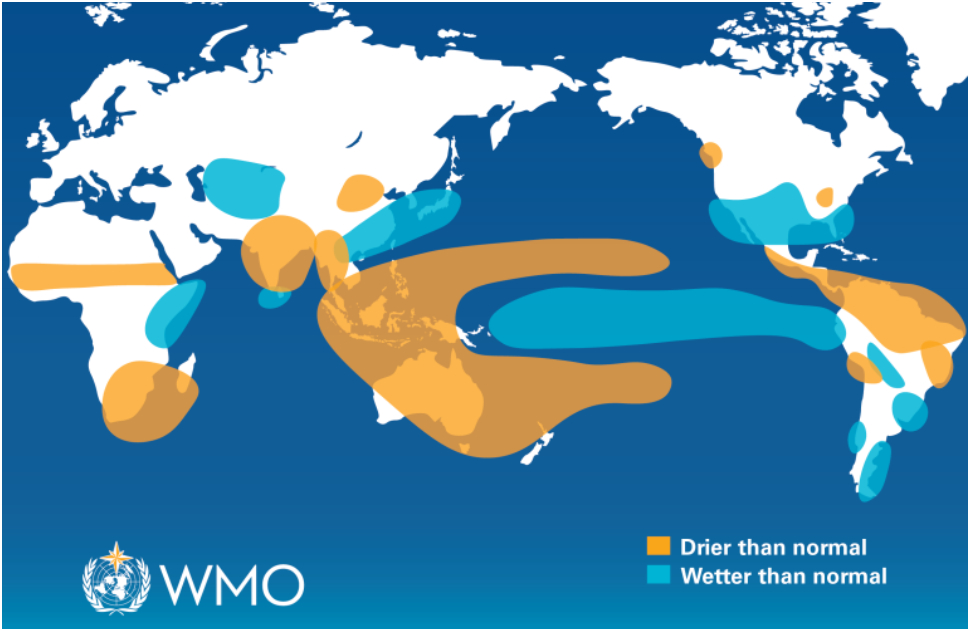
The main conclusion for the region is that the El Niño effect on Central Asia is minimal. According to data presented at the press conference, the phenomenon is primarily due to a slight increase in winter precipitation (January–April), which in itself does not pose a problem. A much more serious long-term trend for the region is a decrease in summer precipitation and the associated water shortages, but this trend is determined by global climate change, not El Niño.
The most significant impacts of the phenomenon – risks of crop failure and food insecurity – are predicted for Southeast Asia, India, East Africa and Central America, as well as for fisheries off the coast of South America.
The main message: do not lose sight of the anthropogenic factor
Responding to journalists’ questions about whether more detailed regional forecasts should be expected from national hydrometeorological services, Alexey Kokorin noted that for Central Asia, the El Niño effect is too weak compared to other, more significant weather factors—cyclones and anticyclones—which hydrometeorological services monitor on a regular basis.
The key point made during the discussion was that active discussion of El Niño in the public space should not create the illusion that the climate agenda is limited to natural fluctuations in the climate system.
El Niño is a natural, cyclical, and well-studied process, while human activity remains the determining factor in climate change. According to the expert, the rate of global temperature increase due to anthropogenic factors is approximately 0.25–0.3°C per decade, while even the strongest El Niño can add no more than 1.5°C in the short term—an effect that is swamped by the global trend within a few years, especially since El Niño is inevitably followed by a La Niña phase, which has the opposite effect.
“Interest in El Niño should not distract from the main issue—anthropogenic global warming and its consequences,” Alexey Kokorin emphasized, noting that this factor has been, is, and will continue to be decisive for the planet’s climate.