
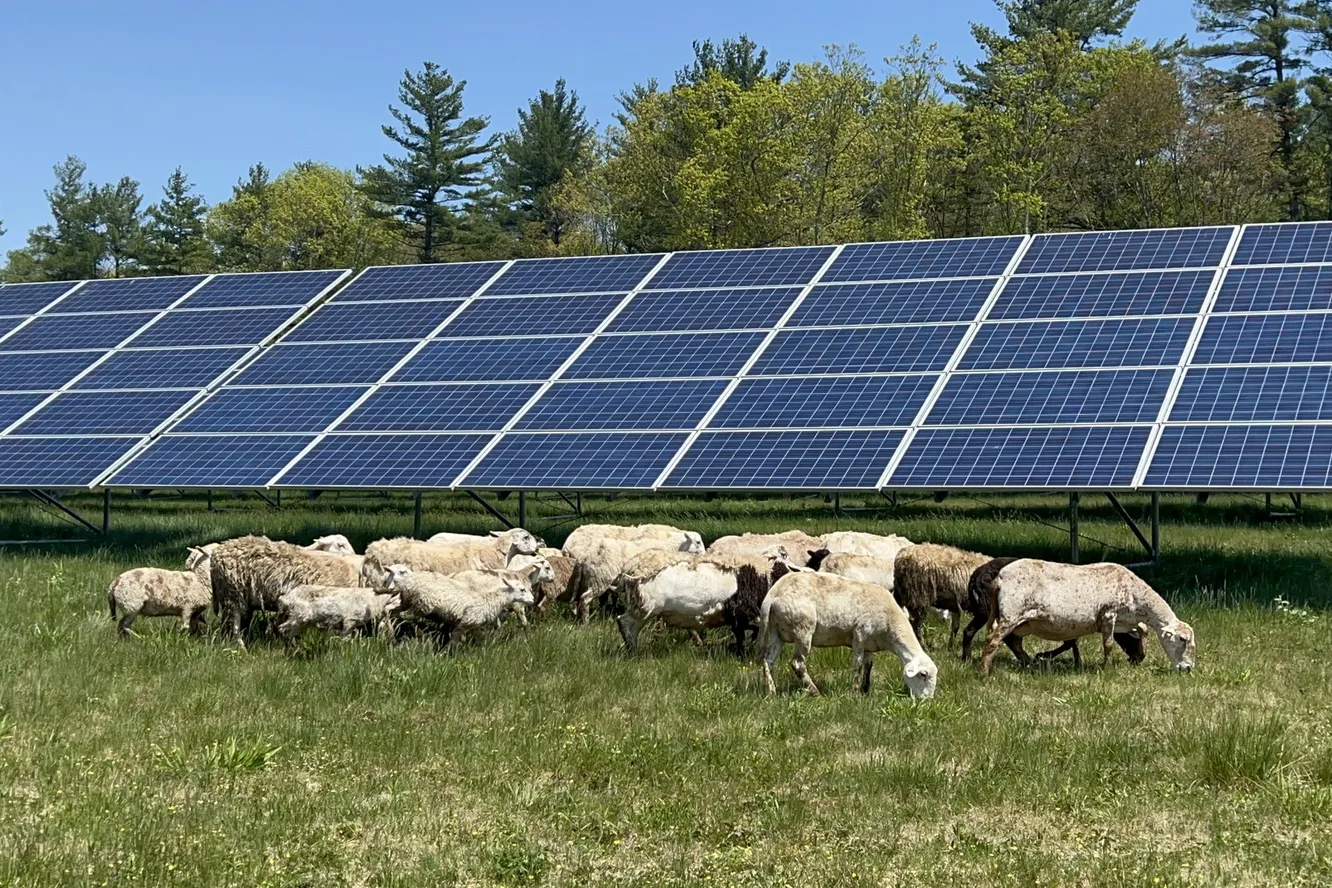
Canada is experiencing a “solar sheep” boom, with demand for shepherds growing rapidly and wages for these “specialists” now on par with those of doctors, lawyers and senior engineers.

“Solar sheep farming” is one of the variants of agrovoltaics, that is, a combination of agriculture and photovoltaics (solar energy).
This cohabitation of the ancient craft of herding and new energy yields synergies in a variety of ways, scientists Joshua Pearce of Western University and Adam Gash of the Ivie School of Business have found. A description of their research, in which they were assisted by herder photographer Rafael Lara, was published in The Conversation .
Sheep + Electricity: What’s the Benefit?
Solar panels protect the earth from the scorching rays of the sun and slow down the weathering of the soil, so any solar power plant quickly becomes overgrown with grass. It is logical to send sheep to the power plant, which eat this vegetation, which prevents the panels from generating electricity. It is profitable for both power engineers and farmers: the power plant saves on the services of mowing vegetation. Sheep remove vegetation even more carefully than agricultural machinery, which often damages the panels.

Since power plants are usually surrounded by a fence, the sheep are not threatened by predators on their territory: lynxes, wolves, coyotes and others, the population of which in Canada is now quite large. The sheep themselves feel better in the shade of the panels than in an open meadow.
Finally, dual use of land provides savings on rent.
Scientists have conducted calculations for several sheep-voltaics business models and in each case the possibility of obtaining high profits has been confirmed.
These calculations are confirmed in practice: the income of Canadian photo shepherds exceeds the income of ordinary shepherds by an average of 2-3 times.
There are problems too
Despite the benefits of such a business, it has its own challenges that one must learn to solve effectively.

Firstly, the SES does not have the water that sheep need: it has to be brought in by truck, and that is not cheap.
Secondly, although sheep farming on the territory of solar power plants is a profitable business, crop production turned out to be an even more profitable occupation.
However, sheepvoltaics is still at the very beginning of its development. It will be interesting to observe how this direction will develop.
https://www.techinsider.ru/news/news-1674625-ovcevody-bez-uma-ot-solnechnyh-elektrostancii-zarplaty-vyshe-chem-u-advokatov/