

Spanish scientists from the Institute of Materials Science and Technology (ICMS) in Seville have developed an unusual hybrid perovskite-based solar cell capable of simultaneously converting both solar radiation and the energy of falling raindrops into electricity. The technology combines the classic photovoltaic effect for sunlight with the triboelectric effect for raindrops. Essentially, it’s an all-weather solution.
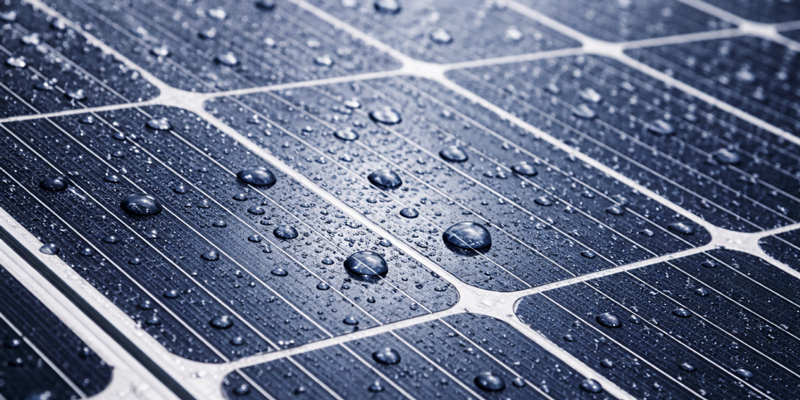
Image source: pv-magazine
The basic idea is straightforward: creating a multifunctional device that operates most effectively in variable weather conditions, especially in regions with frequent precipitation. The cell’s design utilizes a perovskite layer to generate solar energy, topped with a thin fluorinated polymer layer of CFₓ, which possesses several important properties: high transparency (over 90%), hydrophobicity, and the ability to generate triboelectric energy.
This protective layer, deposited at room temperature in a vacuum using plasma spraying, protects the sensitive perovskite from moisture while simultaneously allowing energy harvesting from raindrop impacts. When a raindrop strikes a surface and detaches, contact and charge separation occur between the materials, generating an electrical pulse.
The development, carried out by the 3DScavengers and Drop Ener projects with support from the European Research Council and the Next Generation Fund, opens the door to more versatile solar panels. While sunlight still provides the primary source of power, additional energy from rain accelerates battery charging in cloudy weather. However, scaling the technology beyond laboratory prototypes remains challenging and requires further research.
Google machine translated