
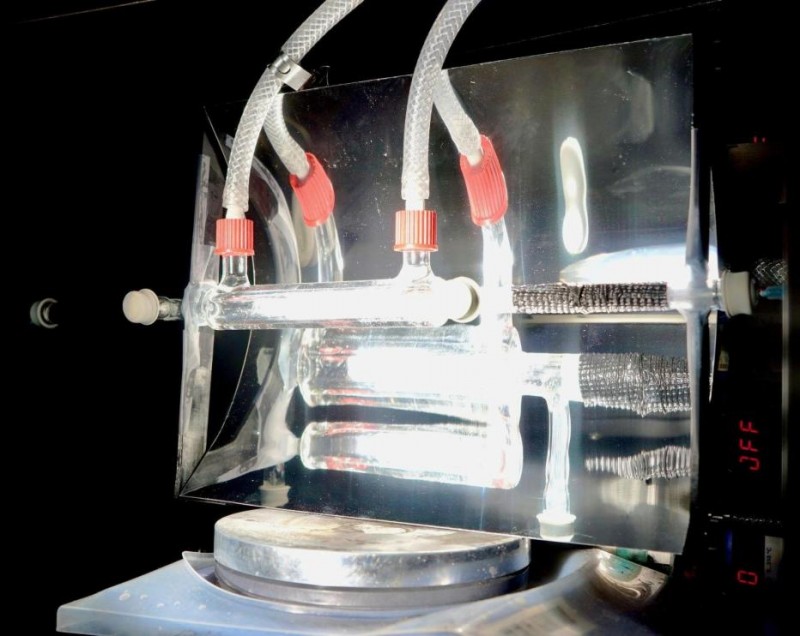
A group of scientists led by chemist Erwin Reisner from the University of Cambridge have developed a new device. It collects (captures) CO2 and converts it into fuel. Instead of electricity, sunlight is used for the conversion.
The reactor absorbs CO2 from the air at night and converts it into synthesis gas using sunlight during the day, the researchers report in the journal Nature Energy. This can be used to make many chemicals and pharmaceuticals or processed into fuel.
Direct air capture — a method of removing carbon dioxide directly from the Earth’s atmosphere and recycling it — is considered a promising technology for actively removing greenhouse gases from the atmosphere in the fight against the climate crisis. However, despite the progress, the technology is still very energy-intensive, expensive, and does not produce products of economic value, the scientists wrote in their study.
This also applies to the capture and storage of CO2 deep underground (Carbon Capture and Storage, CCS).
“In addition to being expensive and energy intensive, CCS also involves burning fossil fuels,” Reisner told APA.
The chemist has been working for over a decade at the University of Cambridge in the UK on converting CO2 into an energy source using sunlight to achieve a circular economy.
He draws inspiration from the processes involved in photosynthesis. While plants produce glucose using sunlight and photosynthesis, Reisner and his team are working on solar-powered processes that can produce fuels such as syngas or alcohols directly from CO2 and water at room temperature.
Over the past few years, the researchers have created several prototypes, constantly improving them and developing them in several directions. Most recently, they presented an artificial leaf that can simultaneously produce green hydrogen and purify water using solar energy.
The latest system, which has already been implemented, absorbs CO2 from the air at night using special filters. The filter is a solid adsorbent made of amino silicon dioxide, which chemically binds CO2 with high affinity (according to Wikipedia, in biochemistry, affinity (also binding affinity) is a measure of the tendency of molecules to bind to other molecules).
During the day, sunlight is concentrated by a parabolic mirror and directed to a flow reactor. The heat of the concentrated sunlight releases CO2 in the filter. At the same time, the sun’s ultraviolet rays are absorbed by a powder made from a semiconductor photocatalyst.
 The device turns sunlight and CO2 into fuel. Photo: University of Cambridge
A chemical reaction is initiated that converts carbon dioxide into synthesis gas. To carry out the necessary chemical reaction, the catalyst is wetted with an aqueous solution of ethylene glycol. Ethylene glycol was extracted from PET bottles “so that PET plastic can also be recycled into valuable chemicals.”
It’s important that the technology works in principle, Reisner says, even if the volume of syngas produced is currently less than one milliliter. His team is working on several approaches to improve the device.
Testing of a larger version could begin in the spring.
“We are also developing more advanced catalysts that will use visible light and thus increase the amount of synthesis gas produced,” says the researcher.
Reissner’s lab is also working on converting syngas into liquid fuels that can be used in cars and planes. Syngas is also seen as a promising candidate for use in the chemical and pharmaceutical industries.
“If we produce these devices at scale, they could solve two problems at once: removing CO2 from the atmosphere and creating a clean alternative to fossil fuels,” lead author Sayan Kar of Reissner’s team said in a press release.
“The advantage of this approach is that no CO2 transport or storage is required . In addition, the system can be used anywhere and is independent of emission sources,” Reisner emphasized.
Larger reactors could be used in a decentralized manner, and theoretically each person/business could produce their own fuel. This would be especially useful in remote or off-grid areas.
https://overclockers.ru/blog/kosmos_news/show/208918/Himiki-iz-SShA-razrabotali-ustrojstvo-prevraschajuschee-CO2-v-toplivo-s-pomosch-ju-solnechnogo-sveta