

Global emissions are still growing – but very unevenly.
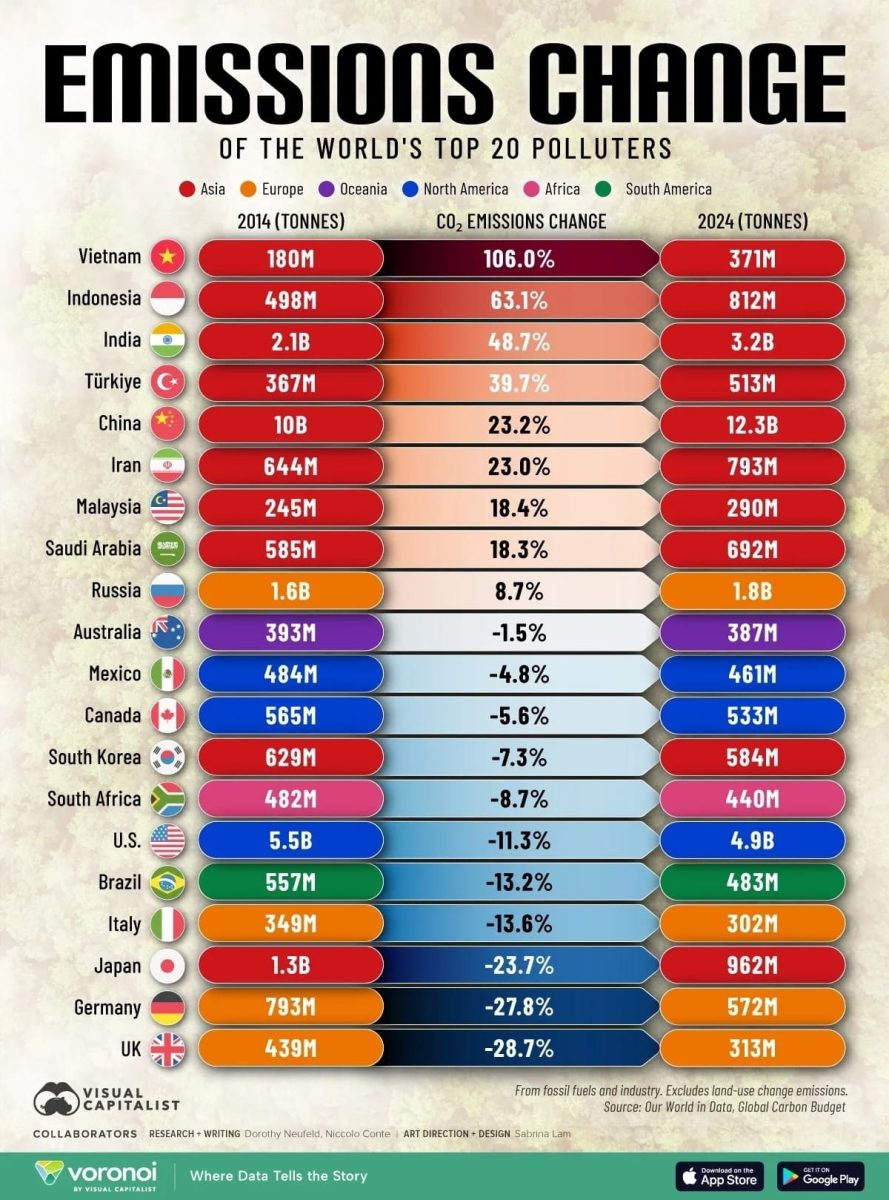
Over the past decade, the most rapid growth has occurred in rapidly industrializing economies. Vietnam more than doubled its emissions between 2014 and 2024, while Indonesia and India also saw sharp increases amid rising energy demand.
At the same time, a number of developed countries are moving in the opposite direction. Countries such as the UK, Germany, and Japan have significantly reduced carbon emissions, largely due to the transition away from coal and the active adoption of renewable energy sources.
According to the Global Carbon Budget, the visualization compares the largest emitters based on how their CO₂ emissions from fossil fuels and industry have changed from 2014 to 2024. Together, these countries account for approximately 80% of global emissions.
Among the largest issuers, the fastest growth rates are concentrated in Asia: Vietnam (+106%) is the clear leader, followed by Indonesia (+63.1%) and India (+48.7%).
At the same time, several developed economies significantly reduced their emissions. The largest declines were seen in the UK (-28.7%), Germany (-27.8%), and Japan (-23.7%) over the same period.
These trends highlight a widening gap: Emissions are growing fastest in developing economies, while many developed countries are reducing them.
Looking at absolute volumes, the key role is still played by the two largest emitters – China and the United States, on which the global climate trajectory largely depends.
China’s emissions grew by 23.2%—an increase of 2.3 billion tons since 2014. This increase alone exceeds the annual emissions of most other large countries combined. In contrast, the United States reduced its emissions by 11.3% to 4.9 billion tons, primarily due to a sharp decline in coal use.
India remains the third-largest emitter, with its carbon footprint growing by 48.7% over the past decade. However, there is an encouraging sign: in 2025 (excluding the pandemic year of 2020), emissions growth rates were the lowest in two decades, at just 0.7%, thanks to record clean energy development.
As energy production and demand shift increasingly toward emerging markets, future emissions trends will increasingly depend on how quickly these economies can transition to low-carbon energy sources.
Google machine translated