

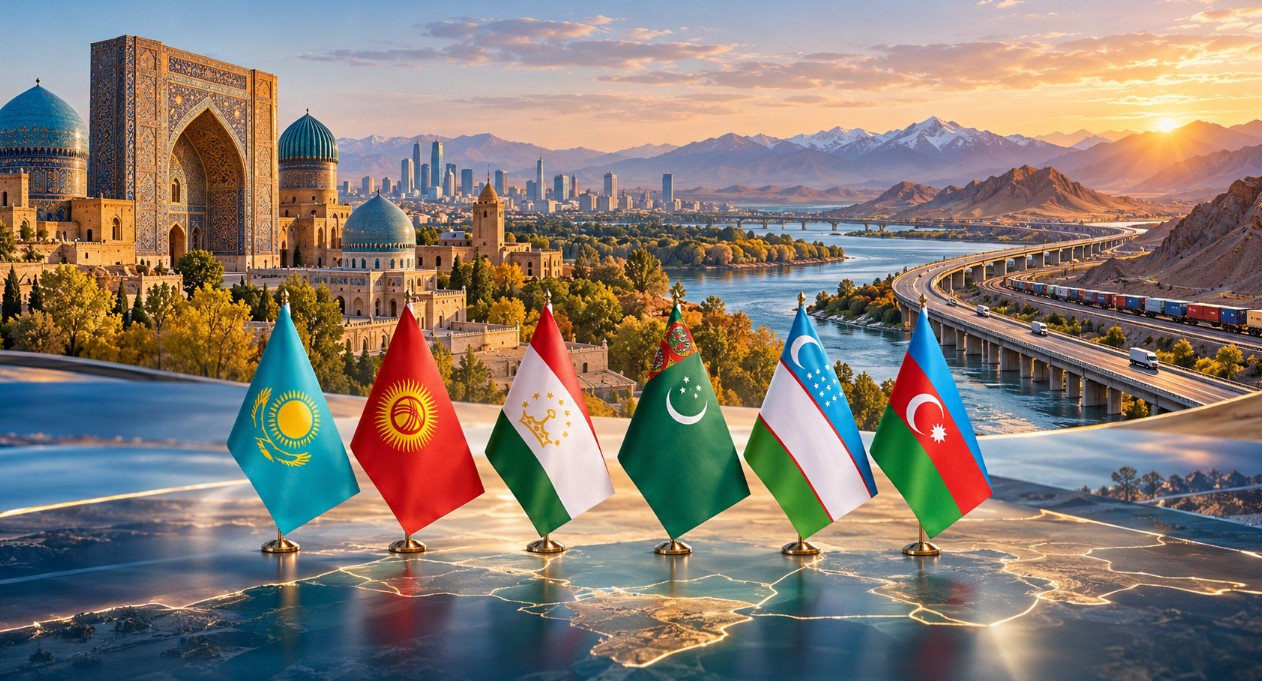
Central Asia is entering a new phase of regional cooperation. The emerging model is not a replica of the European Union and does not envision the creation of a supranational bloc. The states of the region are developing a more flexible format based on sovereignty, political dialogue, practical interaction, and a strengthening culture of regular consultations.
From fragmentation to coordination
For many years, Central Asia has often been described primarily through the prism of fragmentation. Kazakhstan, Kyrgyzstan, Tajikistan, Turkmenistan, and Uzbekistan are linked by shared geography, history, infrastructure, and environmental challenges, but unresolved border issues, water disputes, trade barriers, and a lack of political trust have hampered cooperation.
Today, this approach no longer reflects the ongoing changes. Over the past decade, the region has entered a new phase: political dialogue has become more regular, practical interaction has expanded, and the culture of consultation itself is gradually becoming institutionalized.
One of the key factors behind these changes has been the transformation of Uzbekistan’s approach to relations with its neighbors. Since 2017, Tashkent has made relations with Central Asian countries a key foreign policy priority and has promoted direct and regular dialogue between the region’s leaders. At the 72nd session of the UN General Assembly in September 2017, President Shavkat Mirziyoyev proposed holding regular consultative meetings of the heads of state of Central Asia. The first such meeting took place in March 2018.
Cooperation without transfer of sovereign powers
Consultative meetings have gradually become the region’s primary political forum for discussing common challenges. However, this format was not initially created as a supranational organization. Central Asia lacks a regional commission with independent powers, a common parliament, or a legal order comparable to the European Union.
Cooperation develops primarily through presidential meetings, ministerial coordination, bilateral and multilateral agreements, and sectoral mechanisms. Institutions exist, but remain compact and controlled by states. In other words, we are talking about institutionalization without transferring sovereignty.
Uzbekistan’s role in this process is more accurately viewed not as an attempt to build a hierarchical integration project, but as a contribution to the formation of a political environment in which regular consultations and practical cooperation have become possible. This is fundamentally important: the emerging regional order depends on the participation and political will of all states involved.
Political trust as a regional infrastructure
The most visible evidence of change is not the emergence of a new headquarters or treaty organization, but the gradual elimination of problems that previously seriously complicated regional cooperation.
In March 2025, Kyrgyzstan and Tajikistan signed a state border treaty, concluding a lengthy negotiation process. Given the previous tensions along certain sections of the border, this agreement improved the political conditions for broader regional cooperation.
Transport connectivity, water resource management, energy, climate resilience, trade, and industrial cooperation are also increasingly viewed as regional issues. For Uzbekistan, a landlocked country surrounded by other landlocked countries, a more predictable regional environment has direct economic and strategic implications.
It was the practical dimension that gave substance to the new regionalism. Political rapprochement was followed by efforts to expand cross-border trade, improve transport links, and coordinate responses to common challenges.
Uzbekistan and the institutional evolution of regional cooperation
The Seventh Consultative Meeting of the Heads of State of Central Asia, held in Tashkent on November 16, 2025, under the chairmanship of President Shavkat Mirziyoyev, marked another stage in this process. The leaders decided to admit Azerbaijan to the format as a full participant.
The Tashkent meeting also demonstrated that the mechanism is becoming more structured while maintaining its intergovernmental nature. During Uzbekistan’s chairmanship, the regional agenda expanded to encompass security, interregional cooperation, industry, agriculture, the environment, culture, and other areas.
The sequence of development matters. In Central Asia, institutionalization largely followed political rapprochement rather than preceded it. Initially, states restored dialogue, reduced bilateral tensions, and expanded practical interaction. Formal mechanisms developed later, gradually and selectively.
This approach can be defined as sovereignty-preserving regionalism: states strive for deeper coordination while avoiding the transfer of political powers to a single regional center.
From regional rapprochement to international recognition
External partners are increasingly engaging with Central Asia as a more coherent regional space. A prime example was the first European Union-Central Asia Summit, held on April 4, 2025, in Samarkand. The summit, chaired by President Shavkat Mirziyoyev, brought together the leaders of the five Central Asian states and the European Union.
Following the meeting, relations between the European Union and Central Asia were elevated to the level of a strategic partnership. The agenda included transport connectivity, trade, energy, water resources, climate, critical raw materials, and other areas that are difficult to effectively address solely through five separate bilateral tracks.
For Uzbekistan, holding the summit in Samarkand reflected an important component of its regional policy: strengthening Central Asia’s collective international agency without substituting a single regional center for national foreign policy. Closer coordination does not require regional states to take a unified position on every issue. It allows for the identification of areas of converging interests and the use of joint interaction to achieve practical results.
A model with its advantages and limitations
The emerging model has clear advantages. It reduces political barriers to cooperation, maintains national responsibility for decisions, and allows for the advancement of practical initiatives without first resolving sensitive issues of supranational authority.
However, it also has its limitations. The consensus principle can slow down decision-making. A lightweight institutional structure can lead to uneven implementation of agreements, and regional cooperation remains vulnerable to shifting political priorities, economic shocks, or new disagreements. Its sustainability will ultimately depend on whether established cooperation practices can be maintained during periods of diverging national interests.
The next stage should therefore be assessed not so much by the number of summits, but by whether political agreements lead to sustainable results in the areas of transport, trade, water and energy resources, climate change adaptation, security and contacts between societies.
Why Central Asia’s experience is important beyond the region
Central Asia is of interest to the discussion of regionalism precisely because its model is unlike that of the European Union. The European experience has long influenced ideas about the logic of regional cooperation: states interact, create common institutions, adopt uniform rules, and, in certain areas, devolve some authority to the supranational level.
Central Asia is moving along a different path. The region’s states are developing an increasingly dense system of political consultations and practical interdependence, while maintaining a clear commitment to sovereignty and intergovernmental decision-making.
Uzbekistan has made a significant contribution to this process by promoting a more open regional political environment, initiating regular consultative dialogue among Central Asian leaders, and linking political rapprochement with practical cooperation. However, this process is inherently collective: its development depends on the willingness of all participating states to align national priorities with shared regional interests.
Central Asia may never become another European Union—nor does it have such a goal. The significance of its experience lies elsewhere: the region is capable of becoming more united, coordinated, and visible on the international stage by pursuing its own institutional path.
Jakhongir Isaev,
Head of Department, NGO “Center for Sustainable Development”, Uzbekistan
Google machine translated