

About a quarter of China’s land is classified as desert, and campaigns to contain and restore sandy lands have been underway since the 1970s.
In the arid regions of northern China, dozens of workers are pruning goji berry bushes that grow under the protection of thousands of solar panels.
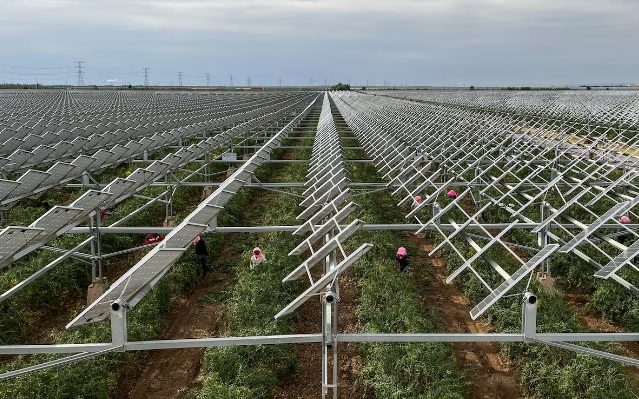
Solar panels are seen at a farm owned by Ningxia Baofeng near Yinchuan, Ningxia Hui Autonomous Region, China, September 16, 2025. REUTERS/Lewis Jackson
The 1-gigawatt power plant, located in the northwestern region of Ningxia, is part of a vast grid spanning northern and western China. This grid uses solar energy and the shade provided by the panels to combat desertification.
According to Liu Yuanguan, the company’s deputy chairman, Ningxia Baofeng, a leading player in the coal chemical industry, plans to build a solar power plant with a total capacity of 30 GW. Part of this capacity will be used to restore ecosystems and combat desertification. A similar 1 GW project is already underway in neighboring Majiatan.
Liu Yuanguan noted during a tour of the facility organized by the Chinese government that the solar panels located above act as mini-umbrellas. They cast shade on the plants and soil, reducing moisture evaporation.
Approximately a quarter of China’s territory is classified as desert, and campaigns to contain and restore sandy lands have been underway since the 1970s. The idea of using solar panels to combat desertification became part of the country’s flagship “Three Norths” project, launched in 1978 and designed to last until 2050.
The standard method involves installing panels to create shade over desert-hardy seeds and shrubs, as well as constructing barriers to slow winds and prevent sand drift. The Ningxia government reports that achieving results could take up to five years.
Projects like Baofeng’s initiative represent only a fraction of the hundreds of gigawatts of solar panels installed in China annually. However, Beijing has announced plans to significantly increase the number of similar projects aimed at combating desertification using solar energy.
Building solar panels in desert areas also helps preserve agricultural land. In 2023, China introduced regulations banning the installation of solar panels on arable land. State media criticized the construction of solar power plants on fertile agricultural land.
China plans to install 253 GW of solar power between 2025 and 2030 to regenerate about 7,000 square kilometers (2,700 square miles) of land, four times the size of Greater London, according to plans by the National Development and Reform Commission (NDRC) and two other agencies.
By comparison, 50 GW of solar power plants were commissioned in the United States last year.
The NDRC did not provide comment on the plan.
Despite the use of solar panels and other methods such as tree planting, progress in combating desertification is not easy. In 2022, desertified land accounted for 26.8% of China’s territory, down from 27.2% ten years ago, despite large-scale reforestation programs.
In the Baijitan Nature Reserve, located a few hours’ drive from Baofeng’s site, approximately 800 square kilometers of desert land have been restored over the years.
The facility’s director, Wang Xiaoling, emphasized that the goal is not to completely destroy the deserts, but to minimize damage.
“This is a long-term struggle for control of the deserts,” he noted. “We cannot claim that we can completely destroy them.”
Prepared by ProFinance.Ru based on materials from Thomson Reuters
https://www.profinance.ru/news2/2025/09/23/ch75-kitaj-ispolzuet-solnechnye-paneli-dlya-borby-s-pustynnymi-peskami.html