

QAZAQ GREEN. Researchers at Nanjing University, working with the industrial team at Renshuo Photonics, have developed a new surface-passivation method for perovskite solar modules. The technology enabled the team to produce a 0.72-square-meter module with a certified efficiency of 22%.
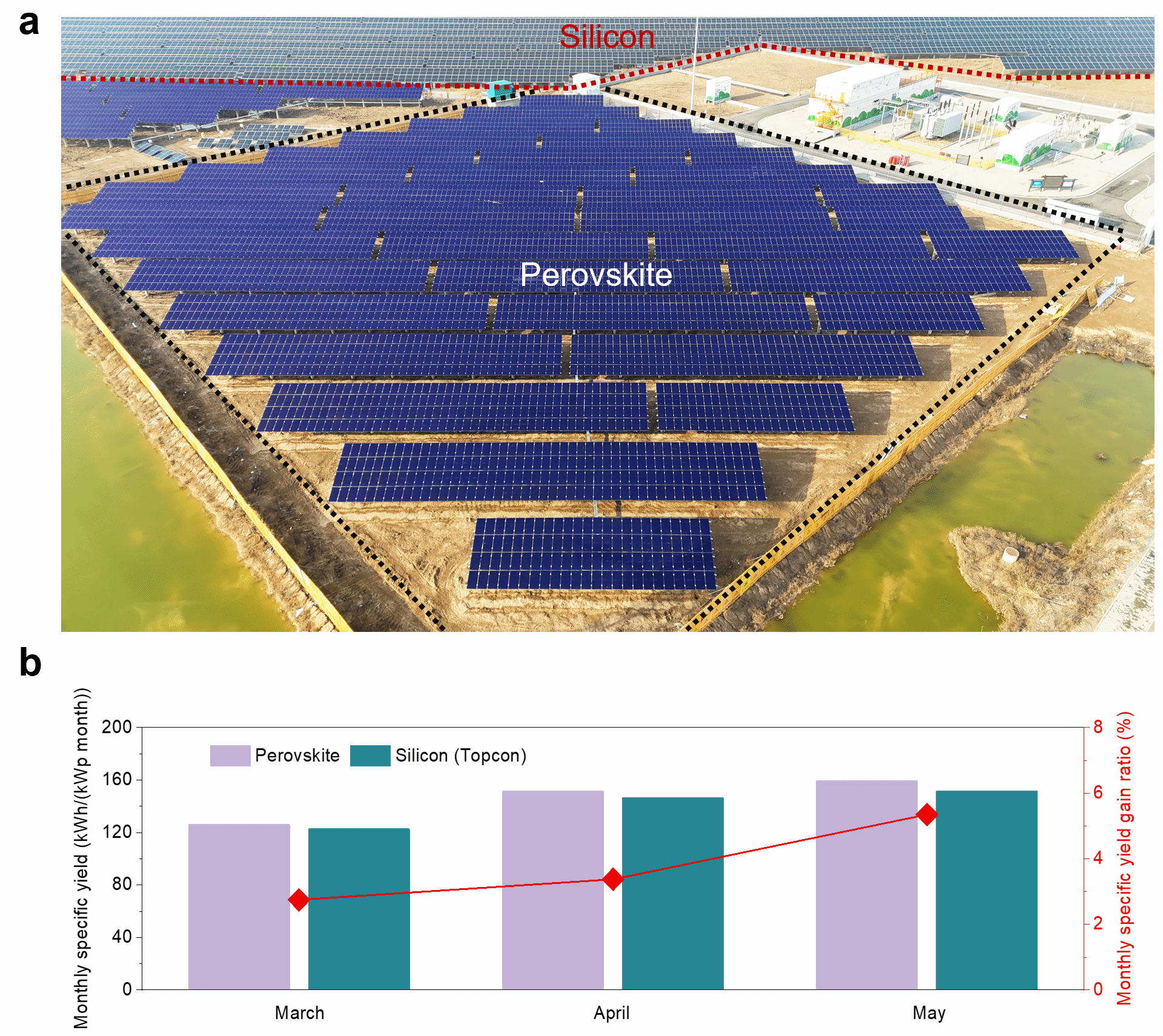
The study was published in Nature. The researchers also tested the technology under real-world operating conditions. During a three-month field trial at a large ground-mounted solar plant, the perovskite system achieved higher electricity generation per unit area than a crystalline-silicon TOPCon system installed at the same site.
Perovskite solar cells are considered one of the most promising next-generation photovoltaic technologies. They offer the potential for high efficiency and relatively low-cost solution-based manufacturing. However, scaling the technology from laboratory cells to large commercial modules remains a major challenge.
One of the key obstacles has been surface passivation. Conventional ammonium halide materials can reduce defects in perovskite films, but they are sensitive to moisture and difficult to apply uniformly over large areas.
The Chinese team developed a two-step approach in which an organic-salt-rich layer is first formed on the perovskite surface and then treated with lead carboxylate. The protective layer was formed using a mixture of 2-methoxyethanol, 1,3-dioxolane and dimethyl sulfoxide combined with vacuum-assisted crystallization.
The researchers found that lead carboxylate forms strong chemical bonds with the perovskite surface. This improves energy-level alignment at the interface and facilitates more efficient charge transport.
The team first produced an 810-square-centimeter module with a certified efficiency of 24%. It then developed a commercial-size module measuring 1.2 by 0.6 meters, with a total area of 0.72 square meters. The module achieved a certified efficiency of 22% and a steady-state output power of 158.4 watts.
The technology also improved module stability. In damp-heat tests conducted at 85°C and 85% relative humidity, the efficiency of a module using a conventional ammonium-based passivator fell by 39% after 1,300 hours. The module treated with lead carboxylate lost only about 2% of its efficiency. During 300 thermal cycles between −40°C and 85°C, the new module showed almost no efficiency loss.
The module also passed the full certification testing sequence under IEC 61215 and IEC 61730, international standards used to assess the reliability of photovoltaic modules.
In the field trial, the researchers compared a 1-MW perovskite system with a 3.5-MW crystalline-silicon TOPCon system. From March to May 2026, the perovskite system generated 3.42% more electricity per unit area in March, 3.79% more in April and 5.81% more in May. Its advantage increased as temperatures and solar irradiance rose.
The researchers said the results demonstrate the potential for further scaling and commercial deployment of perovskite photovoltaic technology.
https://qazaqgreen.com/en/news/world/3783/