

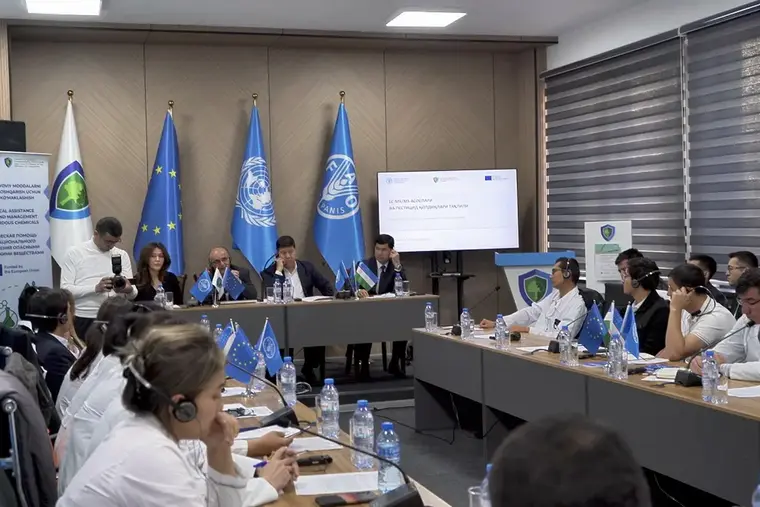
Photo: FAO Uzbekistan.
Tashkent, Uzbekistan (UzDaily.uz) — Classes are being held from October 26 to 29 at the National Center for Environmental Monitoring (NCEM) and are being taught by international laboratory specialist Mohammad Nazem Shirazi.
The program focuses on the theory and practice of liquid chromatography coupled with tandem mass spectrometry (LC–MS/MS). This state-of-the-art analytical system was recently installed at the National Center for Evaluation and Microbiology and is used to analyze pesticide residues.
The training is attended by laboratory specialists from the National Center for Environmental Management, the regional departments of ecology and climate change of the Fergana, Samarkand, Tashkent, Surkhandarya, and Navoi regions and the Republic of Karakalpakstan, as well as the Republican Center for Agrochemical Analysis and the Agency for Waste Management and Circular Economy Development.
Reliable pesticide residue analysis is essential to detect environmental contamination, inform regulatory decisions, and protect public health.
Improving the skills of staff in using modern equipment strengthens the national environmental monitoring system and ensures reliable, traceable analytical results.
The third stage continues the quality management and chemical safety training that took place in June and August 2026.
The four-day program includes familiarization with equipment, development and calibration of analytical methods, quantitative data processing and interpretation of results, quality assurance and quality control in accordance with ISO/IEC 17025:2017 requirements, as well as troubleshooting and preventive maintenance.
Theoretical training complements practical exercises, provided the equipment is ready and the necessary standard samples, reagents, and consumables are available. Furthermore, the training allows for an assessment of the system’s operational readiness and the identification of technical requirements for future support.
Upon completion of the training, participants should gain enhanced skills in operating an LC-MS/MS system, analyzing pesticide residues, and applying quality assurance and control procedures and data verification. Further mentored practice and technical support will help expand environmental monitoring capacity across the country’s network of laboratories and agencies.
“Modern equipment only brings real benefits when laboratory staff are confident in its use and obtain reliable results. This training links instrumentation with quality assurance, helping to transform analytical data into informed environmental decisions,” said Mohammad Nazem Shirazi, an international laboratory specialist.
“Strengthening our laboratory’s analytical capacity is a priority for the National Center for Environmental Monitoring. The introduction of LC-MS/MS technology and the enhanced training of our staff in using this equipment is an important step toward obtaining reliable and internationally recognized data on pesticide residues in environmental samples. This will expand our ability to fulfill our environmental monitoring mandate and help us make informed decisions regarding chemicals management in Uzbekistan,” noted Rustam Ergashev, Director of the National Center for Environmental Monitoring.
Background: The European Union-funded FAO project “Technical Assistance for the Sound Management of Hazardous Chemicals” worth €3.9 million aims to reduce environmental degradation in Uzbekistan.
To achieve this, the project improves pesticide management, strengthens chemicals management systems and promotes sustainable agricultural practices.
Google machine translated