

Against the backdrop of climate change and growing water scarcity, the importance of water in Kazakhstan continues to grow. At the same time, the role of specialists responsible for its efficient use is also increasing. In honor of Water Resources Day, Kazinform has prepared an overview of key reforms, achievements, and pressing issues in the sector.
From deficit to effective management
In recent years, climate change, shrinking glaciers, dependence on transboundary rivers, and growing agricultural demand have transformed water security in Kazakhstan into a national issue. Experts predict that if current trends continue, the country’s water deficit could reach 15 billion cubic meters by 2030.
Recognizing these challenges, the government has embarked on a comprehensive modernization of the water management sector. In recent years, large-scale reforms have begun, encompassing legislative, infrastructural, and technological areas. A new Water Code has been adopted, and the modernization of irrigation infrastructure continues. Digital management systems are being implemented, and the use of water-saving technologies is expanding. Furthermore, priority attention is being given to personnel training and the adoption of international best practices.
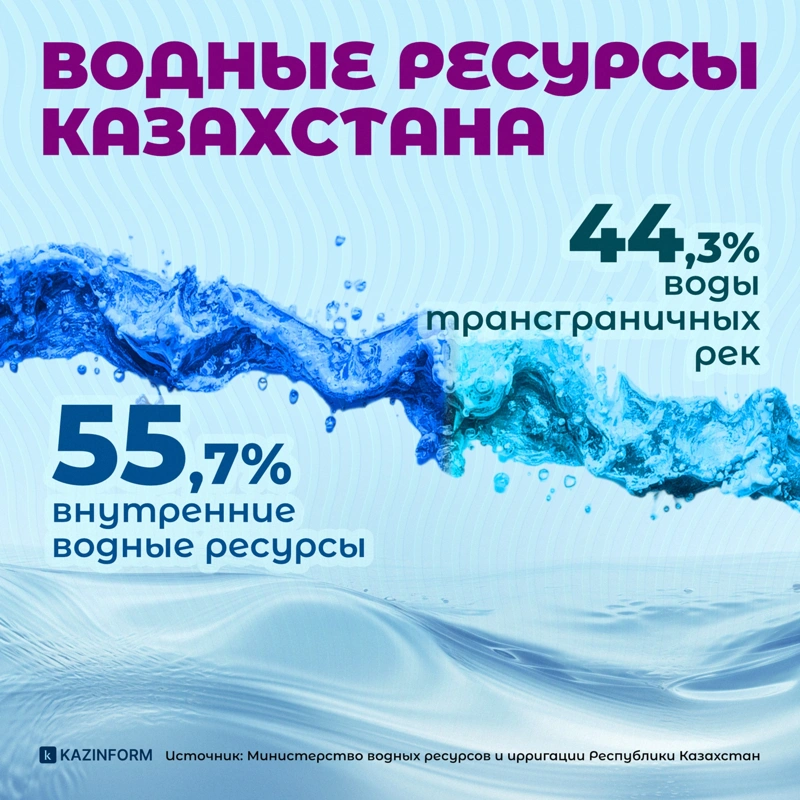
However, ensuring water security is not limited to domestic reforms. One of the key characteristics of Kazakhstan’s water resources is that a significant portion is generated outside the country. Currently, only 55.7% of water resources are generated within the country, while the remaining 44.3% arrives via transboundary rivers from China, Kyrgyzstan, Uzbekistan, and Russia.
This feature directly impacts the water management system. In Kazakhstan, water resources are managed on a basin-wide basis and encompass eight watersheds. However, water availability varies significantly across these basins. While the Irtysh and Balkhash-Alakol basins have significant water reserves, the Nura-Sarysu basin has limited water supplies. The southern and western regions of the country are directly dependent on water supplies from neighboring countries.
According to Kuanysh Uzbekov, a water policy expert at the Qazaq Expert Club, since Kazakhstan is located in the downstream reaches of transboundary rivers, implementing an effective water policy in conjunction with neighboring states is of strategic importance.
“About half of our country’s river runoff is generated outside the republic’s borders. Therefore, developing a long-term and mutually beneficial water policy with neighboring states is imperative,” the expert says.

Along with dependence on transboundary water resources, climate change is increasingly impacting water supplies. According to scientists, the volume of glaciers in the Tien Shan mountain system has significantly decreased in recent decades. This could further impact the natural recharge of rivers.
In this regard, the Ministry of Water Resources of Kazakhstan considers global warming, glacier degradation, increased water consumption in the upper reaches of transboundary rivers, and the economy’s dependence on water resources to be among the main risks.
Agriculture remains the primary water consumer. In 2024, this sector consumed approximately 60% of all water withdrawn. According to experts, the problem lies not only in the volume of water resources but also in the efficiency of their use. Due to worn-out irrigation systems and losses in open canals, a significant portion of the water is lost before it reaches agricultural land. Therefore, the primary challenge today is to manage available water resources as efficiently as possible and ensure the rational use of every cubic meter.
Record investments: what projects are already underway?
The results of reforms aimed at ensuring water security are reflected primarily in the volume of funding allocated to the sector. Over the past two years, investment in the water sector has reached a record level, and infrastructure development has accelerated significantly.
According to Nurzhan Nurzhigitov, Minister of Water Resources and Irrigation of the Republic of Kazakhstan, approximately 400 billion tenge in investments were attracted into fixed capital in the water sector in 2025 alone. This is 22% higher than planned.
“Over the past two years, investment in the sector has totaled 676.7 billion tenge. This exceeds the previous three years. The majority of these funds were used to modernize irrigation infrastructure. During this period, approximately 1,500 kilometers of irrigation canals were lined with concrete, and the volume of mechanized canal cleaning increased severalfold,” the minister noted.
The bulk of the attracted investment is being directed toward the implementation of specific infrastructure projects. This allows for the gradual modernization of irrigation systems.
While 700 kilometers of irrigation canals were reconstructed last year, this year another 986 kilometers have undergone major repairs. Additionally, four reservoirs have been modernized, and the reconstruction of four more reservoirs and the construction of three new reservoirs are planned.

Infrastructure development is proceeding in parallel with legislative reforms. The new Water Code has become a key document in this area. For the first time, it enshrines the concept of “water security” at the legislative level. Additionally, targets have been set for the construction of 20 new reservoirs in the coming years, the modernization of 15 hydraulic structures, the restoration of 14,000 kilometers of irrigation networks, and the reduction of water losses to 25% by 2030.
However, experts believe that the problem cannot be solved solely by constructing new canals and reservoirs. In the face of increasing water shortages, the primary focus must be on accurate water resource metering and the widespread adoption of digital technologies.
The Role of Digital Solutions
In this regard, Kazakhstan is prioritizing the digitalization of its water management system. While previously efforts in this area were limited primarily to water consumption metering, today automated control systems for hydraulic structures, remote regulation of hydraulic gates, and real-time water distribution are being gradually implemented. This not only reduces water loss but also improves the efficiency of irrigation systems.
According to the ministry, one of the largest projects in this area is the second phase of modernization of irrigation and drainage systems in southern Kazakhstan. The project is currently nearing completion. Once operational, it is expected to significantly improve the reliability of the water supply system and significantly reduce water losses.
Along with government agencies, domestic engineers are also participating in the implementation of digital solutions. One such development is automated control valves for irrigation canals. The system automatically regulates water supply according to the farmer’s actual needs and continuously monitors its volume using ultrasonic flow meters.
According to Kuanysh Zikirbay, a tutor at the K. Satpayev Kazakh National Research Technical University, such technologies make it possible to monitor the movement of every liter of water.
“In the face of increasing water shortages, accurate metering and efficient distribution of water resources are particularly important. Automated systems make this possible,” he says.
The government has now begun developing a unified intelligent water resources management system. This will allow for the coordination of water resource management at the national level.
To this end, the Water Resources Information Center is adapting the Talsim program, developed in Germany, to Kazakhstan’s conditions. The system currently integrates data from the country’s eight largest river basins, including weather, precipitation, snow accumulation, river runoff, and reservoir conditions, and generates water resource forecasts.
According to the Center’s Managing Director, Nurlan Abaev, this model allows for the advance calculation of water volumes entering reservoirs and the ability to prepare for emergencies in advance.

“If the water volume is expected to be large, measures are taken to prevent flooding. If the water supply is expected to be low, the necessary reserves are stockpiled in advance. Furthermore, the system takes into account the situation in neighboring countries and allows for effective planning of water use from transboundary rivers,” he explains.
This is of particular importance for Kazakhstan. As noted earlier, almost half of the country’s water resources depend on transboundary rivers flowing from neighboring countries.
DeepBas: A New Era of Water Security Forecasting
The next stage of digitalization in the industry will be the implementation of artificial intelligence technologies. While today’s focus is on automating water metering and management, the next challenge will be creating an intelligent model capable of predicting water management system performance in advance.
To this end, Kazakhstan is proposing the DeepBas (Deep Basin Spatiotemporal AI) project. Its main objective is to create a national digital water resources model. This system will not only allow for real-time monitoring of rivers, reservoirs, and canals but also proactively model potential risks. For example, it will be able to predict in advance which region may experience water shortages during a drought, or which reservoirs will be at risk during spring floods.
According to Akhilbek Kurishbaev, President of the National Academy of Sciences of the Republic of Kazakhstan, implementing such a system represents a much larger task than digitalizing individual processes.

“All information about water movement, climate change, surface and groundwater must be integrated into a single intelligent system. Only then can we make scientifically sound and effective decisions,” says the academician.
According to the Ministry’s plans, work in this area will be carried out in stages, with a fully-fledged digital water resources management ecosystem to be established by 2028. This will enable prompt decision-making in water management, more accurately forecast water shortages and natural hazards, and elevate water security to a whole new level.
The main goal is to save water
The ultimate goal of digitalization and infrastructure modernization is to maximize the efficient use of available water resources. This is especially important for agriculture, as it accounts for approximately 60% of all water consumed in Kazakhstan. Therefore, in the context of increasing water shortages, the widespread adoption of water-saving technologies has become a priority for state policy.
According to the ministry, efforts in this area have already begun to yield initial results. Last year, the implementation of water-saving technologies saved 874 million cubic meters of water. In recent years, the pace of implementation of such technologies has also increased severalfold. While previously they were implemented annually on average over 30,000 hectares, today this figure has reached 150,000 hectares.

As a result, the area of agricultural land using water-saving technologies continues to steadily increase. Last year, it reached 543,500 hectares. By 2030, this figure is planned to reach 1.3 million hectares.
At the same time, experts believe that, along with the introduction of new technologies, modernizing irrigation infrastructure is also crucial. They believe the government needs to shift to economic incentives for the implementation of water-saving technologies. This will not only motivate farmers to more widely adopt modern solutions but also ensure the efficient and targeted use of public funds.
How is personnel training carried out?
The successful development of the industry depends primarily on the qualified specialists who support it. Therefore, strengthening human resources has become a key focus of state policy. To this end, state support for specialist training is being increased. In the 2026-2027 academic year, 1,000 state grants have been allocated for water management majors. Currently, 2,629 students are studying in these fields at higher education institutions across the country.

However, the main goal is not only to train new specialists but also to motivate them to pursue long-term careers in the industry. As Minister Nurzhan Nurzhigitov noted, close cooperation with educational institutions has been established in this area.
“To this end, the Ministry has signed memoranda with higher education institutions and colleges, arranging for students to undergo industrial training at branches of Kazvodkhoz, the Water Resources Information and Analysis Center, the National Hydrogeological Service, and research institutes,” said Nurzhan Nurzhigitov.
To address the labor shortage, alongside improving the education system, priority is being given to improving the social conditions of industry workers. Over the past two years, salaries at Kazvodkhoz have been gradually increased, reaching an average monthly salary of approximately 300,000 tenge. Wages for entry-level workers have nearly doubled. Furthermore, 425 employees who were previously employed on a seasonal basis have been transferred to permanent positions.
International cooperation
In developing its water sector, Kazakhstan places particular emphasis on international experience. Since its establishment, the Ministry of Water Resources and Irrigation of the Republic of Kazakhstan has consistently expanded its cooperation with international partners.
During this time, the Ministry has signed four international agreements and more than 20 memoranda of cooperation. The Ministry and its subordinate organizations have established partnerships with government agencies, international organizations, development agencies, and leading companies in France, Germany, the Netherlands, Spain, the United States, Israel, and China.
To coordinate this work, the Water Sector Development Partners’ Coordination Council was established in September 2024. The Council coordinates joint water management projects and provides technical, financial, and advisory support. It currently comprises 47 organizations and entities. These include the ambassadors of the United Kingdom, France, Switzerland, Israel, the Netherlands, and Hungary, the United Nations Development Programme Office in Kazakhstan, the OSCE Programme Office in Astana, the Delegation of the European Union, as well as international financial institutions and other major organizations.
One of the concrete results of this cooperation was a trilateral agreement signed in December 2024 between the Ministry of Water Resources and Irrigation of the Republic of Kazakhstan, the French Development Agency (AFD), and the French Bureau of Geological and Mining Research (BRGM). The agreement will conduct a comprehensive study of the Lake Balkhash basin and allocate a €1.35 million grant for the development of a master plan for the lake’s conservation.
Kazakhstan is also strengthening cooperation with Asian countries. China is a key partner in this area. Last year, the two countries signed their first memorandum of understanding on water resources. The document provides for cooperation in the efficient use of water resources, the implementation of modern technologies, the use of alternative water sources, and the training of industry specialists.
The agreement is already being implemented through specific projects. This year, Kazakhstani specialists began advanced training courses in the Chinese city of Changsha, where they are gaining practical experience in implementing digital technologies. The program is being implemented through a partnership between Kazvodkhoz and Power China International Group Limited. This collaboration will expand gradually. By the end of the year, approximately 200 Kazakhstani specialists will have completed advanced training in China .
Thus, water management modernization is not limited to the construction of new canals or the repair of hydraulic structures. Infrastructure upgrades, digitalization, the implementation of water-saving technologies, the study of international experience, and the training of qualified specialists are being implemented as interrelated areas of a unified effort.
As a reminder, the Water Council met yesterday, chaired by Prime Minister Olzhas Bektenov . As part of the Water Resources Management System Development Concept and the Comprehensive Water Sector Development Plan, 160 measures are being implemented with a total funding of 3.2 trillion tenge.
Google machine translated
https://www.inform.kz/ru/kakkazahstan-moderniziruet-vodnoe-hozyaystvo-7a0da4c6