

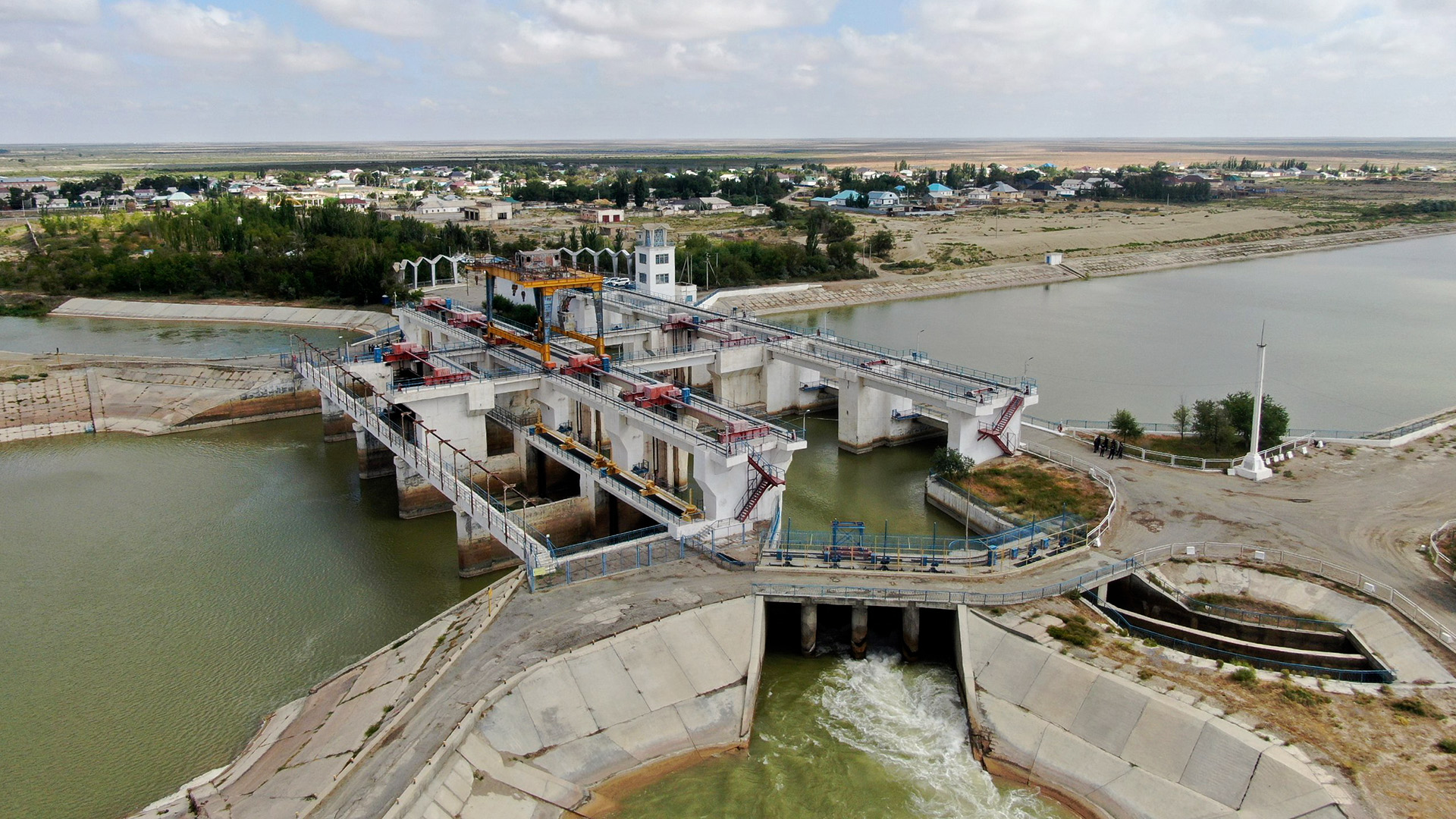
Kazakhstan is rebuilding its water infrastructure.
By 2030, the country plans to build 42 new reservoirs, reconstruct 37 more, and modernize 14,500 kilometers of irrigation canals—all while digitizing water management, reports DKNews.kz .
The large-scale restructuring of the industry is taking place within the framework of the instructions of Kassym-Jomart Tokayev, outlined in the Presidential Address “Kazakhstan in the Era of Artificial Intelligence: Current Challenges and Their Solutions through Digital Transformation.”
The Government of Kazakhstan reported on current progress . Some planned projects have already moved from the paperwork stage to construction sites: five reservoirs have been modernized, and over 4,600 kilometers of canals are under construction.
42 new reservoirs should change the water supply map
One of the most capital-intensive parts of the reform is the construction of new water storage facilities.
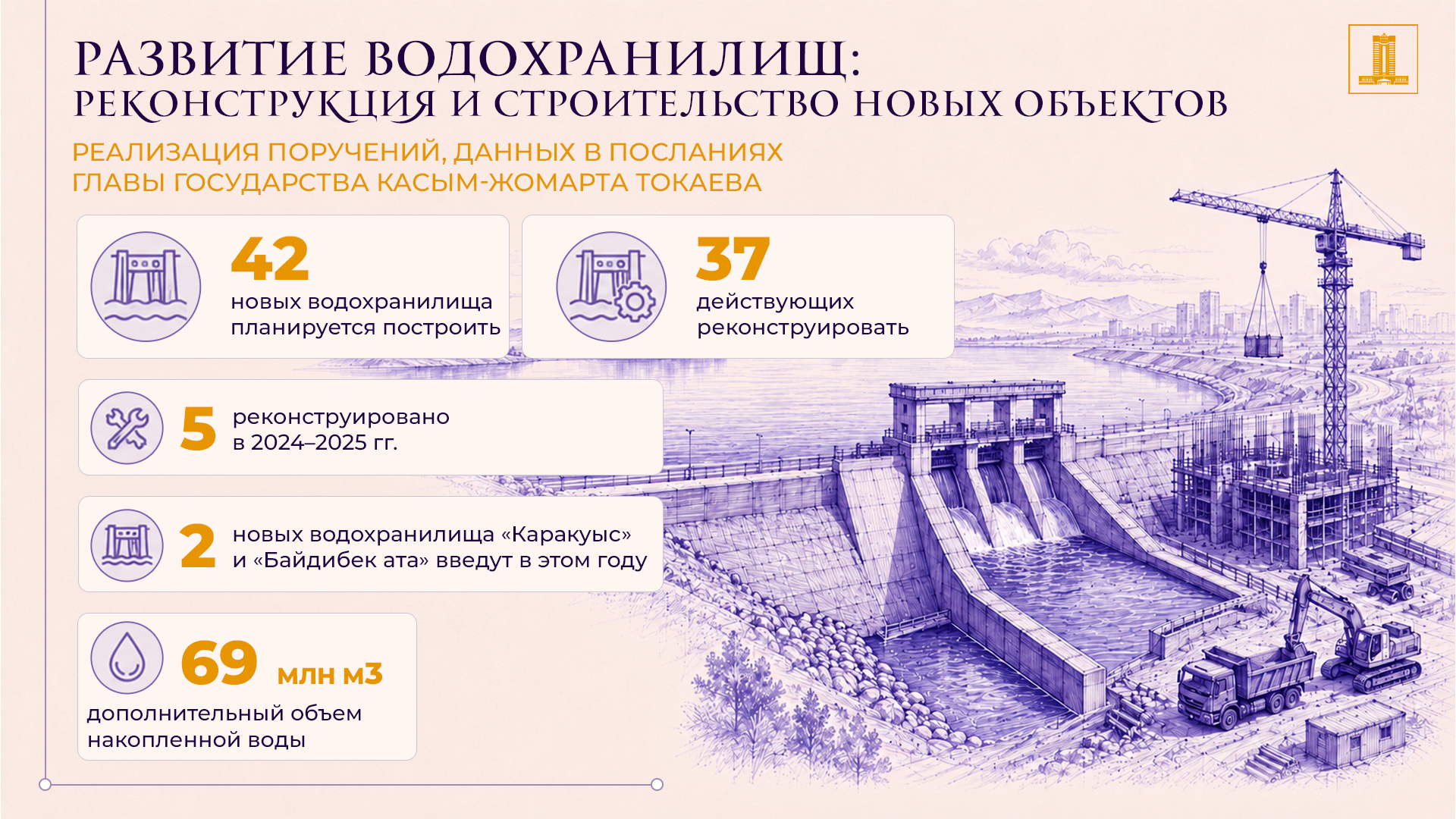
State plans call for the creation of 42 new reservoirs and the reconstruction of 37 existing ones . Five facilities in the Aktobe, Turkestan, West Kazakhstan, Abay, and Zhetisu regions will be renovated between 2024 and 2025.
Construction of the Karakuys and Baidibek Ata reservoirs continues in the Turkestan region . Their completion is scheduled for 2026. Together, they should provide an additional storage capacity of approximately 69 million cubic meters of water .
Next in line are the Akmola reservoir projects in the Zhambyl region, the Karauzyak reservoir in the Kyzylorda region, and the Bolshoy Uzen reservoir in the West Kazakhstan region. Financing for the project preparation is provided by the first tranche of a loan from the Islamic Development Bank.
At the same time, reconstruction of the Koksaray reservoir in the Turkestan region is planned.
For Kazakhstan, this isn’t just a question of the irrigation season. The new reservoirs should allow for the redistribution of water between periods of high and low inflow, while some of the infrastructure is also used for flood control.
More than 4.6 thousand km of canals are already in operation
Building reservoirs will not solve the problem without upgrading the canals that carry water to the fields.
By 2030, the government plans to modernize 14,500 kilometers of irrigation canals . More than 1,400 kilometers were reconstructed and modernized between 2024 and 2025 , with work currently covering over 4,600 kilometers .
An additional 962 kilometers are planned for completion in 2026. According to government estimates, this should improve water supply to approximately 200,000 hectares of irrigated land .
The volume of mechanical cleaning of the irrigation network is also increasing. While 678 kilometers of canals were cleaned in 2023, more than 1,100 kilometers will be cleaned in 2024, and over 1,800 kilometers in 2025.
A separate project is the reconstruction of the Kanysh Satpayev Canal , which is of strategic importance for Central Kazakhstan and the water supply of Astana.
The Big Almaty Canal named after Dinmukhamed Kunayev is next in line. It is planned to be reconstructed in three stages. After modernization, the canal should provide irrigation for 33,300 hectares of agricultural land .
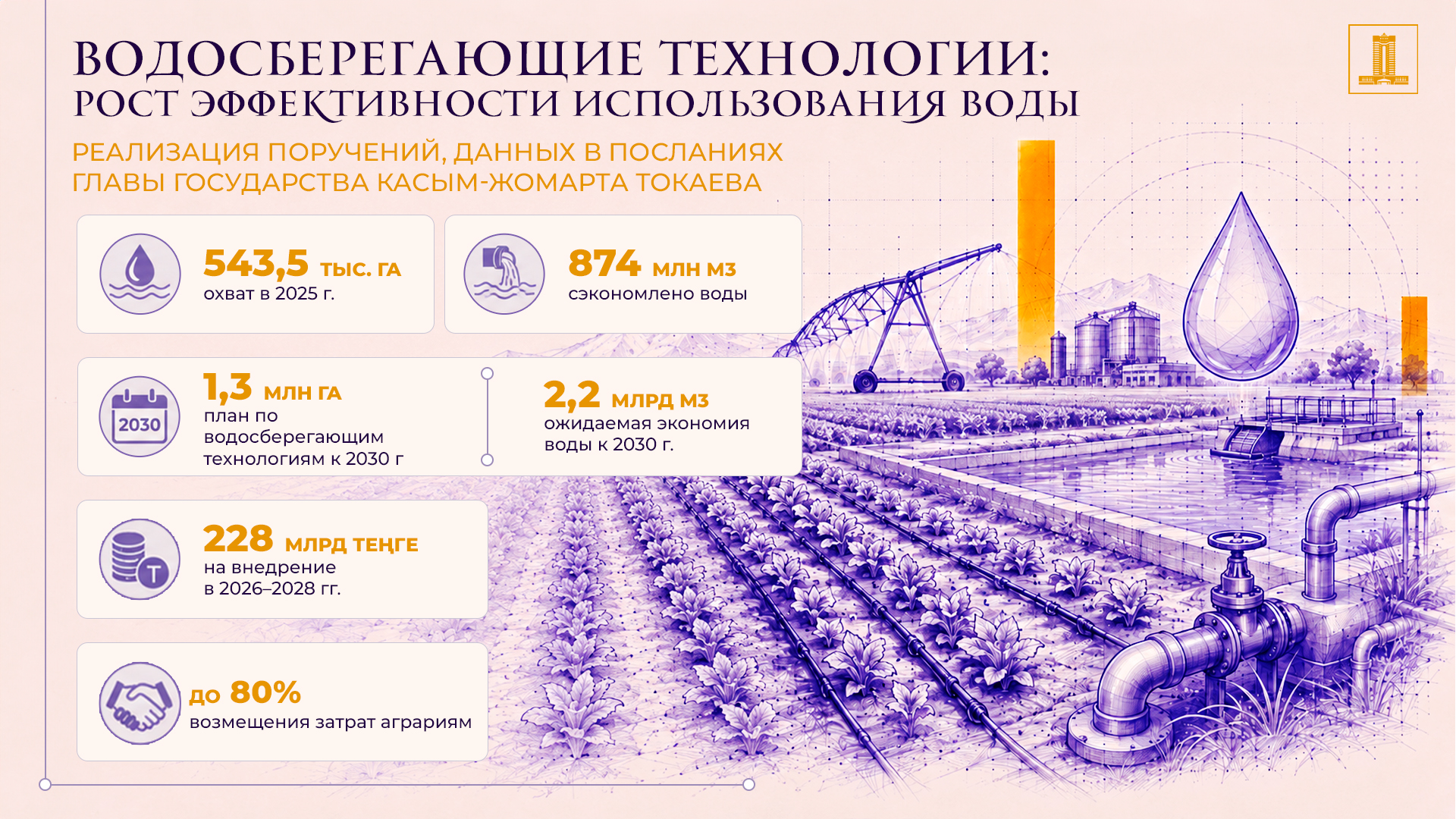
Farmers will be compensated for up to 80% of their costs for water-saving irrigation.
The largest potential for savings lies in the agricultural sector: agriculture accounts for approximately 60% of the country’s total water consumption.
In 2024, the area covered by water-saving technologies increased by another 153,000 hectares, and in 2025, by 154,000. Previously, the annual increase was approximately 30,000–35,000 hectares.
By the end of 2025, modern irrigation technologies were already being used on 543,500 hectares . According to the Ministry of Water Resources and Irrigation , this has saved approximately 874 million cubic meters of irrigation water .
By 2030, the area is planned to increase to 1.3 million hectares , and annual savings to approximately 2.2 billion cubic meters of water .
For farmers, the share of reimbursement for the costs of purchasing and installing water-saving systems has been increased to 80% .
Funding for this area for 2026–2028 is estimated at approximately 228 billion tenge , compared to 55.5 billion tenge for the previous three-year period.
The scale of support demonstrates a shift in priorities: drip and sprinkler irrigation are gradually transforming from a standalone agricultural technology into an instrument of state water policy.
The new Water Code forces businesses to measure their water consumption.
The changes affect more than just farmers.
The new Water Code, which came into force in 2025, enshrined the concept of “water security” and introduced the concept of “ecological flow” —the minimum volume of water necessary to maintain the sustainable state of rivers, lakes, and seas.
New requirements have been introduced for large industrial and heat-producing organizations. They must prepare five-year plans for transitioning to recycled and reusable water supply and modernize existing systems.
168 such plans have already been developed , and enterprises have undergone an inventory.
The state is also developing a mechanism to reduce permitted water use volumes for those who do not comply with established requirements.
For businesses, water is becoming not only a utility resource and a production expense, but also an object of more stringent accounting and regulation.
Fines amounting to hundreds of millions of tenge were issued for violations.
Strengthening control goes hand in hand with modernization of infrastructure.
A roadmap to combat the so-called black market for water is being implemented in collaboration with the Prosecutor General’s Office . It includes an audit of water resources, identification of risk areas, review of infrastructure spending, and anti-corruption measures.
Over 1,000 inspections were conducted in 2025–2026 , and the amount of fines exceeded 316 million tenge .
Space monitoring revealed another 472 violations, resulting in fines totaling over 206 million tenge .
At the same time, basin inspectorates received additional control powers, including the ability to promptly respond to violations in water use.
More than 23 thousand water bodies have been transferred to the digital system
Physical reconstruction is accompanied by the creation of a single digital circuit.
The Ministry has developed the National Water Resources Information System . It consolidates information on water bodies, infrastructure, users, and groundwater.
According to official data from the Ministry of Water Resources , information on more than 23 thousand water bodies has already been entered into the system .
Thousands of digital passports have been created, and organizations and water users are connecting to the system.
Kazvodkhoz also transitioned its interactions with farmers to an electronic format—from application to payment. Since the beginning of 2026, tens of thousands of water supply contracts have been concluded through the billing system.
Digitalization has even reached the canals themselves. In the southern regions, automation has begun on 103 canals with a total length of 857 kilometers , providing irrigation to 65,000 hectares.
Another 270 reconstructed canals with a length of 1,184 kilometers are being converted to automated control.
An additional 264 reconstruction projects are being prepared, providing for modern water metering systems.
Kazakhstan tests flood and low-water forecasting
One of the most technologically advanced elements of the reform is related to forecasting.
Together with UNDP, Kazakhstan is testing the German TALSIM-NG system . It is designed to model river runoff, reservoir inflows, flood periods, and low-flow scenarios.
The system covers the country’s eight largest river basins and is integrated with the Tasqyn program.
The practical meaning of this approach is to move from reacting to an existing flood or shortage to a preliminary calculation of how much water will arrive and how to distribute it.
The Northern Aral Sea has grown to 23.5 cubic kilometers.
Another result is related to transboundary waters.
The volume of the Northern Aral Sea increased from 18.4 cubic kilometers in 2023 to 23.5 cubic kilometers .
Over the past two years, approximately 30 cubic kilometers of water have entered Balkhash , which, according to the government, has helped stabilize the lake’s level.
For the third year in a row, the Kapchagay Reservoir has been fully filled.
The total inflow into the Bukhtarma Reservoir for 2024–2025 reached 58.6 billion cubic meters , supporting the restoration of its filling and regulation of the Ertis River flow.
2.7 thousand springs were added to a single database
Separately, the state is returning to systematic accounting of groundwater.
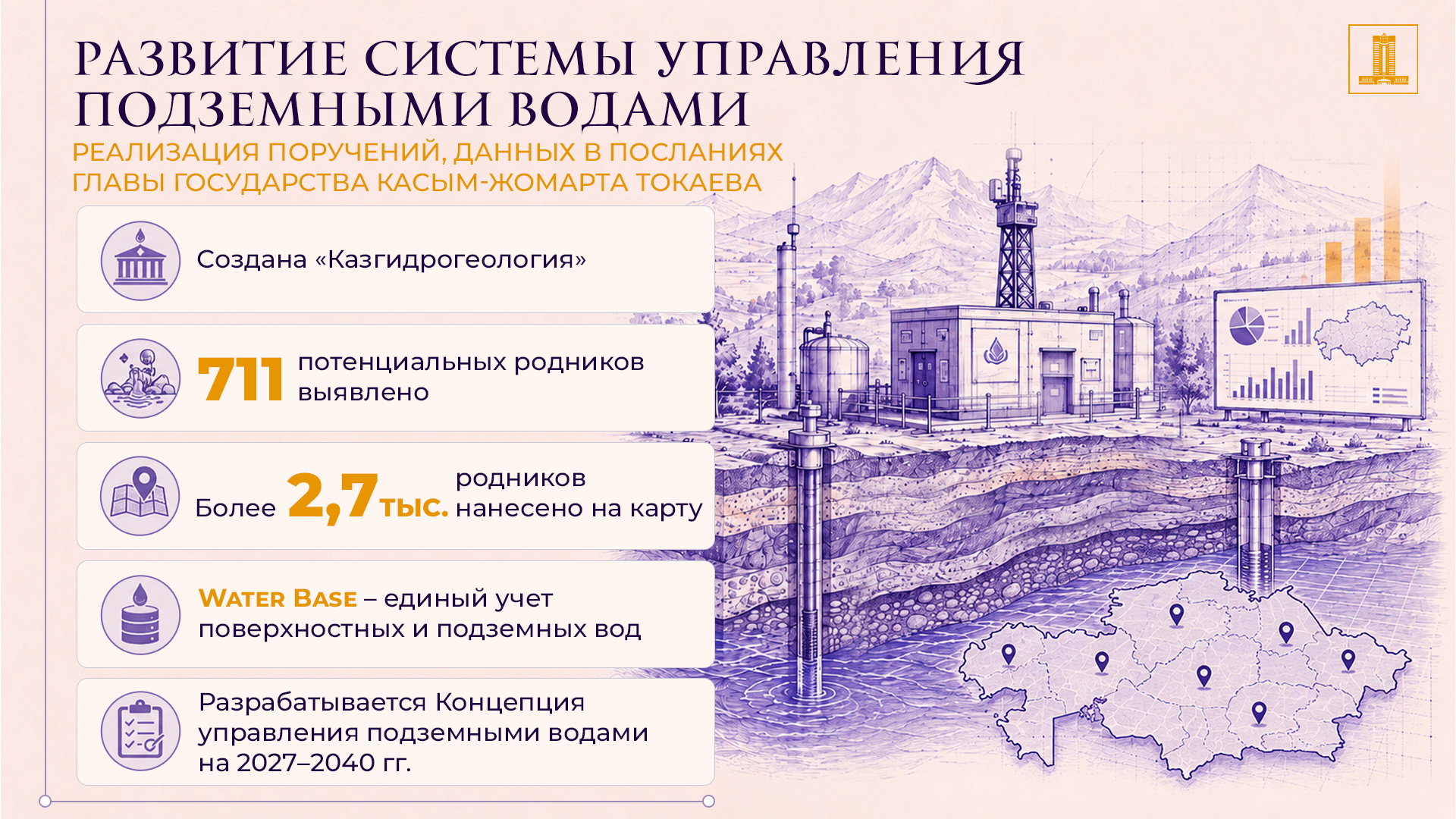
The National Hydrogeological Service “Kazhydrogeology” has been re-established under the Ministry of Water Resources and Irrigation .
Using archival materials, specialists have already mapped more than 2,700 springs and identified another 711 potential sources.
To combine information on surface and groundwater, the Water Base system is being deployed.
At the same time, a Concept for the integrated use and management of groundwater for 2027–2040 is being prepared.
As a result, Kazakhstan’s water reform is gradually expanding far beyond dam construction and canal lining. The system integrates new reservoirs, automated distribution, satellite monitoring, business regulations, and agricultural subsidies.
We previously reported on how Kazakhstan’s adoption of water-saving technologies has accelerated fivefold , reaching 543,500 hectares. The next milestone is significantly higher— 1.3 million hectares by 2030.
Google machine translated