

Central Asian countries are looking for ways to protect themselves from drought.

About the author: Andrey Vasilyevich Zakhvatov is an expert on Central Asia.
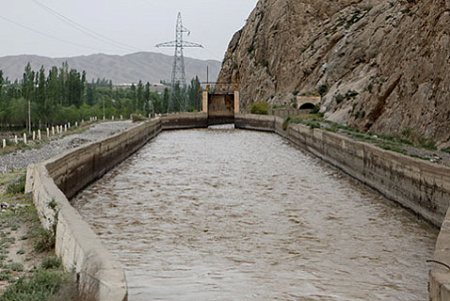
This photo shows one section of Kyrgyzstan’s water distribution system. Photo: Reuters
Kyrgyz President Sadyr Japarov proposed introducing a water fee through compensation for its use. This issue has long been pressing for the entire region, as budget funds are insufficient. The Kyrgyz population has a safety net: several hundred thousand commuter migrants work in Russia, and Kyrgyzstan surpasses Russia in the percentage of the working-age population traveling abroad for work. In March 2025, RIA Novosti, citing the World Bank, reported that “in Kyrgyzstan, the poverty rate among households receiving remittances is less than 10%, whereas without them, it would exceed 50%.”
Figures cited by the media indicate that the republic produces nearly 50 cubic kilometers of water, of which Kyrgyzstan uses approximately 12 cubic kilometers, with the rest going to its neighbors. Strictly speaking, if the water isn’t “conserved” in reservoirs, it won’t be possible to sell it—it will flow away to its neighbors.
Japarov added that by 2100, Kyrgyzstan could lose up to 80% of its glaciers to melting, which would be catastrophic for the country. However, the word “may” alongside the year 2100 and the loss figure is merely a frightening proposition (like Trump’s “500% tariff may or may not happen”). However, Japarov’s proposal is logical, since it is the upstream countries—Kyrgyzstan and Tajikistan—that monitor the condition of their hydraulic structures.
Japarov proposed that countries in the region develop water distribution mechanisms and follow Kyrgyzstan’s example by allocating 2% of their annual budgets to shared water security. The president also mentioned the implementation of water-saving technologies. However, his proposal has not found a response, but only for now, as the issue will have to be addressed sooner or later – every cubic meter of water is precious in Central Asia. Many countries don’t have acute water shortages, but even there, water is often conserved – in Europe, even rainwater is collected.
The idea of charging for water is not new – it is paid for in the United States, Australia, the Middle East, and other countries. Local agreements on water charges also existed in a number of Central Asian countries. According to some reports, the price of 1 cubic meter of irrigation water in Kazakhstan varied depending on the type of crop and the volume being irrigated. Media reports indicated that in the early 2020s, drinking water was free in Turkmenistan, while in some European countries, 1 cubic meter of water cost over $10.
Irrigation water fees also depend on the regional economic level. If poor farms simply cannot afford the costs, some or all of the costs may be covered by regional and national government budgets. If these costs are covered by the budget, the water fee will aim not only to fairly cover the expenses of distribution organizations but also to support the protection of water resources and the growth of profitable production. However, subsidies and support programs are, naturally, a function of the state, and these recommendations are not universal.
All over the world, drinking water, industrial water, and wastewater disposal (sewage) are charged at set rates, and the rates vary widely. The situation with irrigation water also varies. In Eastern countries, water and air are considered free, but today we can only repeat: Japarov’s proposal is not without common sense, if only because without flood protection, the water would create numerous problems for downstream neighbors. This is almost never considered; no one has the extra money. For example, the costs of monitoring the collapse of Lake Sarez in the Pamirs, where 17 cubic kilometers of water are trapped, are of virtually no concern to downstream countries. Safely lowering the water table is out of the question. But if a flood breaks through, it will be devastating for everyone.
During the Soviet era, the demand for cotton led to the near-total depletion of water in the Syr Darya and Amu Darya basins. This isn’t widely discussed, but the Karakum Canal, a long, navigable route that takes water from the Amu Darya, is essentially the region’s retribution for Soviet cotton production, with the dried-up Aral Sea. This is likely why the actual water intake figures for the Karakum Canal and the Afghan Kosh-Tepa Canal are known only to intelligence agencies and are controversial, while Afghanistan has yet to participate in the commission for the division of water in the transboundary Amu Darya.
Today, no one is calling for shutting off the water supply to the Karakum Canal, which has increased cropland by millions of hectares. However, Professor Aza Migranyan, head of the Economics Department at the Institute of CIS Countries, wrote in the journal “Geoeconomics of Energy” (No. 4, 2024): “In fairness, it should be noted that, in order to fill the Karakum Canal, the flow of the Amu Darya and Syr Darya stopped feeding the Aral Sea within their natural flow limits, which significantly contributed to the deterioration of the environmental situation in the Aral Sea basin. At the same time, it is practically ignored that the national economic benefit of the canal’s operation, which created economic potential, continues to ensure economic growth in the Aral Sea countries.”
It’s worth noting that the annual irrigation requirement for one hectare of cotton is up to 10,000 cubic meters of water. This figure is high, so it’s worth noting the statement by Uzbek President Shavkat Mirziyoyev: if inbound tourism were to increase significantly, cotton would no longer need to be planted.
The region truly needs basic legislation. Contracts will have to be signed where technologically linked water management systems operate, and the volume of water consumed can be easily measured with flow meters. However, cost calculations must be meticulous—in 2025, for example, in North Ossetia, the recalculation of actual vegetable garden acreage requiring summer irrigation was suspended. Therefore, under market conditions, paying for water is unavoidable.
Google machine translated