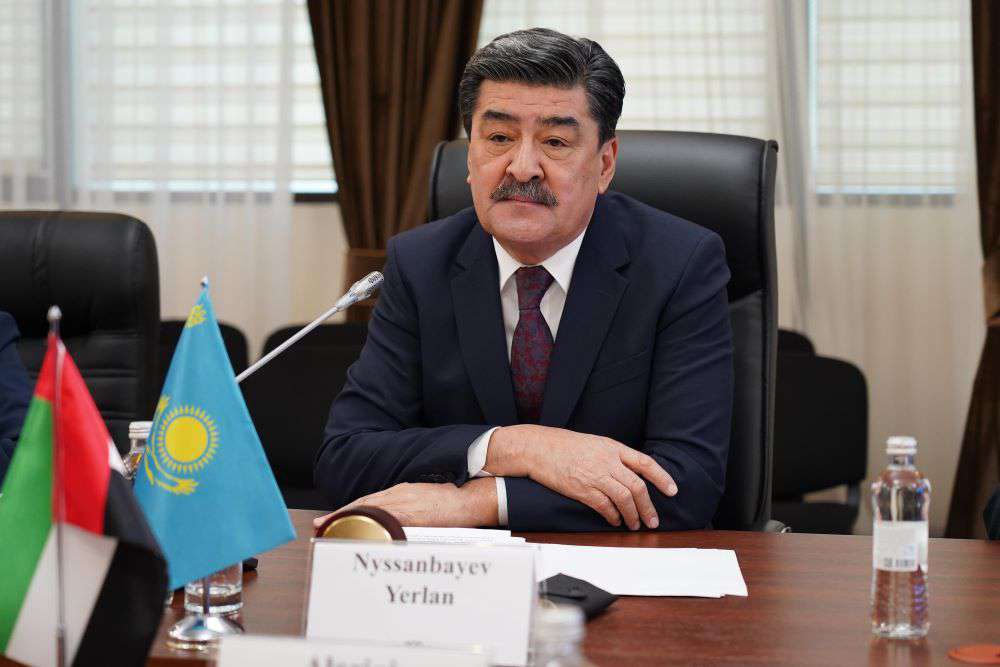
Countries in the region, including Kazakhstan, are trying to mitigate the environmental disaster by resorting to mass planting of saxaul on the dried seabed. How the situation has changed thanks to these measures is discussed in an interview with the Minister of Ecology and Natural Resources of the Republic of Kazakhstan, Yerlan Nysanbayev.
– Erlan Nuralievich, work on afforestation of the dried seabed has been ongoing since the 90s of the last century. Why is this being done and what successes have Kazakhstani foresters achieved?
– Today this territory is often called the Aralkum desert. The total area of the dried bed of the Aral Sea (DBA) is about 6 million hectares, including 2.8 million hectares of this man-made desert located on the territory of Kazakhstan. The most acceptable way to reduce the negative impact of the ecological disaster has become the afforestation of the dried bed with psammophyte plants.
They strengthen the loose salt surface with their roots, resist the removal of salts and are effective in combating shifting sands. The focus was on saxaul, one of the plants that can survive in desert conditions of low water.
From the point of view of ecological physiology, phytocenology and economic accounting, saxaul forests are one of the most unique and characteristic types of plant communities for desert territories. In nature, they are valuable for regulating water resources, melioration, strengthening sands and protecting pastures, and are of interest to humans as an economic resource – a source of fuel.
Of the three species of the genus Haloxylon that are found in Kazakhstan, black and white saxauls have a wide range in the desert regions of the Iran-Turan region and the Arabian Peninsula. Zaisan saxaul is found exclusively in the east and southeast of the republic.
In Kazakhstan, saxaul forests occupy over seven million hectares – about 52 percent of the total forest area. Saxaul never ceases to amaze with its vitality and unique abilities. The roots of one bush can hold up to four tons of sand and salt.
In saxaul plantations, the rate of sand movement in the ground layer decreases by 20 percent in the second year after planting, and by 80 percent after five years. In the seventh year, saxaul plantations on 100 thousand hectares are capable of holding back the removal of over 100 thousand tons of salt, dust and sand into the air. Saxaul changes its habitat, so it can revive life in the desert.
Since independence – from 1991 to 2020 – forest phyto-amelioration work at ODAM has been carried out on 195 thousand hectares. The total forest area, including natural overgrowth, is 371,000 hectares. In 2008–2014, the project “Conservation of Forests and Increasing Forest Coverage of the Republic’s Territory” was implemented in Kazakhstan, financed by a loan from the World Bank and a grant from the Global Environment Facility.
Later, under the auspices of the Forestry and Wildlife Committee of the Ministry of Environment and Natural Resources, together with the Forest Service of the Republic of Korea, saxaul seedlings were planted on 13.3 thousand hectares from 2018 to 2020.
To ensure maximum survival, forest reclamation work is carried out on the basis of scientific recommendations and work projects, with much attention paid to the mechanization of labor.
– What types of plants, besides saxaul, were planted on the bottom of the Aral Sea? Why were they chosen?
– The high salinity of the ODAM dictates the use of only a very limited range of tree and shrub species. The afforestation work is based on the technology of creating forest crops, developed under the supervision of Professor Vladimir Semenovich Kaverin. On less saline soils, saxaul is sown (planted), on more saline soils – halophytes, that is, plants with high resistance to saline soils.
Scientists from the Kazakh Research Institute of Forestry and Agroforestry Melioration named after A. Bukeikhan recommend sowing kandym head of Medusa (zhuzgun) and black saxaul on the dried bed of the Aral Sea; several types of saltwort – Paletsky, Richter, Grebenshchik, oriental and tree-like, as well as black saxaul in sand-accumulating furrows; Caspian saltwort and sarsazan.
Thanks to the long-term work of domestic forestry scientists, the technologies for planting and sowing saxaul and its agricultural technology have been improved. Since 2023, in addition to black saxaul, sowing of Karabak has begun. Currently, KazNIILHA employees are conducting experiments on sowing anabasis, Schober’s saltwort and other halophytes on ODAM using moisture-absorbing substances, fertilizers and growth stimulants. In addition, they are studying the possibility of using unmanned aerial vehicles for sowing seeds on ODAM.
– What other scientific work is being done in the context of reforestation of the exposed seabed?
– Kazakh scientists pay great attention to the study of soils in the region. As a result of long-term observations at ODAM, depending on the salt regime of soils, the level of groundwater and their mineralization, they identified three types of forest growing conditions on which forest reclamation works are carried out: good, satisfactory and conditionally forest suitable. Scientists proposed to develop bottom sediments in three stages. First of all, areas with sandy and sandy loam sediments are planted. Secondly, areas of bottom sediments with a blown sand cover.
And only then is it possible to create melioration plantings on bottom sediments of heavy mechanical composition with a blown sand cover up to 10 centimeters.
The employees of KazNIILKhA have identified four categories of forest growing conditions on the dried bottom of the Aral Sea, which are based on the nature and degree of soil salinization, especially the upper root layer, the depth of groundwater, and its mineralization. Determining the forest suitability group makes it possible to select a range of plants for sowing and planting.
– Erlan Nuralievich, what problems must be solved when growing forests in the extreme conditions of ODAM?
– The ODAM territory has difficult soil and climate conditions, and this is the first problem. Salt marshes prevail here. Young plantings and even adult plants are very sensitive to droughts, frosts and extreme temperatures. All this has a negative effect on their survival.
Second: lack of quality planting material, low survival rate of seedlings and low germination of seeds. If laboratory germination of saxaul seeds averages 62 percent, then in nature it does not exceed 27 percent.
Forest reclamation works at ODAM are financed by large companies. Thus, in March-April of last year, large-scale planting of saxaul was carried out with funds from JSC NC KazMunaiGas. More than 4.4 million seedlings were planted on 15 thousand hectares of the former bottom. At the end of last year, funds from the company KATKO were attracted. At their expense, work was carried out on 132 thousand hectares.
The current year’s plan is 308 thousand hectares, including the ministry’s 208 thousand hectares and the Kyzylorda region akimat’s 100 thousand hectares. The issue of financing the remaining 208 thousand hectares of forest reclamation work is being worked out.
– It is known that a forest nursery has been built at ODAM to provide planting material. In this regard, how will the approaches to planting saxaul and the pace of these works change?
– Indeed, within the framework of the project financed by the World Bank, the construction of a nursery with an area of 33 hectares has been completed in Kazalinsk. Here, according to the project, seedlings of saxaul and halophytic shrubs will be grown for further planting at the ODAM.
The nursery’s capacity is three million seedlings annually. In addition, the ministry plans to create a new forest nursery directly on the drained bottom. The planting material obtained there will be better adapted to the arid conditions of the drained bottom, which will improve the quality of forest crops. A suitable site has been selected for its construction, where a 450-meter-deep well has been drilled, and design and estimate documentation is being developed.
– When can a full-fledged ecosystem be created on the bottom of the Aral Sea? How much time might it take? Does an artificially planted forest have the ability to live as a full-fledged biocomplex?
– Restoration of a full-fledged ecosystem in the ODAM in the form in which it existed before is unlikely. But the phytomeliorative plantations created in Aralkum are already populated by animals, although not in such quantity and diversity as in natural ecosystems. There you can find rodents (for example, gerbils), lizards, snakes, as well as birds that use the forest as a place for rest and nesting during migrations, kulans and tolai hares. The appearance of animals contributes to the spread of plant seeds and the formation of soil biota.
During their life processes, plants enable soil biota (bacteria, fungi and other organisms) to exist. Thus, a new process of soil formation is launched, conditions are formed for the emergence of tree and shrub species.
It is important that the local population has also begun to return little by little, to work on planting saxaul and similar shrubs. For example, last year 280 people worked on such field work. They were assistants to tractor drivers, seed collectors.
Also in March last year, the first eco-volunteer project Syr qorǵany – sekseýil was held, within the framework of which more than 80 volunteers planted over 5,100 saxaul seedlings on the bottom of the Aral Sea. I would like to note the vast geography of the volunteers – Almaty, Talgar, Astana, Tashkent, even the USA. Active citizens of the Kyzylorda region, namely residents of Shieli, Zhanakorgan also took part in the project.
To preserve saxaul forests, on October 30, 2024, the order of the Minister of Ecology and Natural Resources of the Republic No. 260 “On the ban on logging in saxaul forests in areas of the state forest fund” was approved. In this regard, the Kyzylorda Regional Territorial Inspectorate of Forestry and Wildlife constantly conducts raids.
– Tell us about the contribution of neighboring states and international organizations to solving this global problem. Was the exchange of experience useful?
– Considering that the shallowing of the Aral Sea is a global problem, the Ministry of Ecology and Natural Resources is attracting international donors, including the International Fund for Saving the Aral Sea, the World Bank, the German Society for International Cooperation (GIZ) and other organizations to conduct soil survey and consulting work on the ODAM, strengthening the material and technical base of forestry institutions in the Kyzylorda region. The Government of Uzbekistan is also organizing events to plant saxaul on the dry bed of the Aral Sea.
I would like to note that the long-term cooperation between our countries has had a positive impact on the comprehensive solution to the Aral Sea problem.
– What are the short-term and long-term objectives?
– To improve the quality of work at ODAM and provide ongoing scientific support, the Ministry opened a branch of the Kazakh Research Institute of Forestry and Agroforestry in Kyzylorda.
The institute’s specialists will study agrotechnical measures during autumn-spring forestry work on ODAM (correct sowing and planting schemes, collection and processing of forest seeds, digging and transportation of seedlings), engage in scientific monitoring and analysis of the creation of forestry plantations.
In order to support the ecosystem created at the ODAM, it is planned to organize a state forest nature reserve “Aral Ormany” with an area of more than one million hectares on the basis of the Aral Forestry Institution and the Uyaly forestry of the Kazalinsky Forestry Institution and to give it the status of a specially protected natural area.
The reserve’s staff will continue forest reclamation work and ensure the protection of existing plantings.
https://kazpravda.kz/n/saksaul-pustyne-vozvrashchaet-zhizn/