

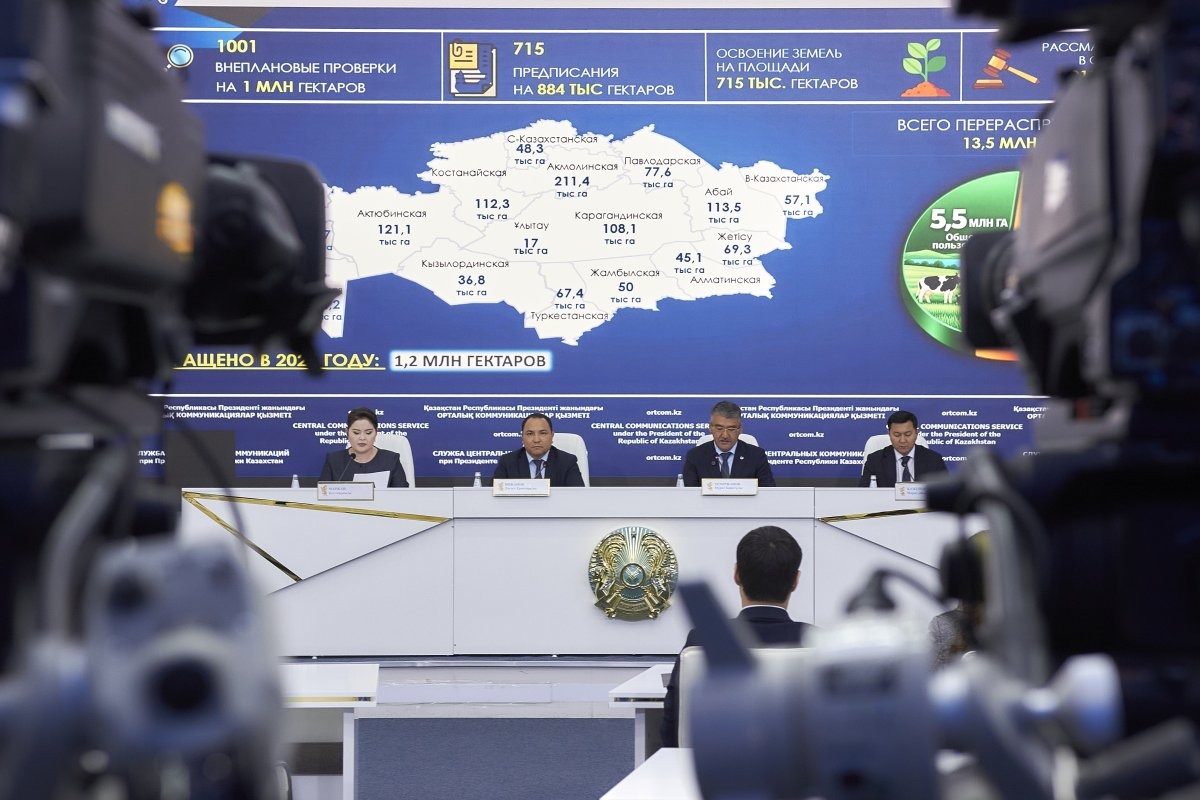
Land is being returned to cultivation. The pasture deficit in Kazakhstan has decreased from 8.4 million to 2.4 million hectares compared to 2023, and all remaining unallocated lands returned to the state have been included in the phased transfer plan, reports DKNews.kz .
Murat Temirzhanov, Chairman of the Land Resources Management Committee of the Ministry of Agriculture, announced this at a press conference at the Central Communications Service.
13.5 million hectares have already received new users
This year, the volume of redistributed land previously returned to the state reached 13.5 million hectares.
Of these, 5.5 million hectares were transferred to the general use of local residents for livestock grazing. Another 8 million hectares were allocated to agricultural producers on a competitive basis.
The reuse of land plots is becoming the next stage of land policy. It’s no longer just a matter of returning unused land to the state, but also of who will use it and for what purposes.
“The discussion shouldn’t be limited to simply returning land to the state. The main goal is to ensure its continued effective use and achieve concrete results. First and foremost, it’s essential to meet the needs of rural residents and agricultural producers,” said Murat Temirzhanov.
The pasture deficit has decreased from 8.4 million to 2.4 million hectares.
One of the most noticeable effects of redistribution concerns rural residents who keep livestock.
According to the Ministry of Agriculture, compared to 2023, the pasture deficit in the country has decreased by 6 million hectares – from 8.4 million to 2.4 million.
The reduction is more than 70% of the 2023 level.
The transfer of 5.5 million hectares into public use means that a significant portion of the returned land was not transferred to new commercial land users, but was used directly to address the problem of livestock grazing.
However, the need is not fully met: a deficit of 2.4 million hectares remains.
The remaining lands will be distributed according to regional plans.
The Ministry of Agriculture has approved a separate plan for the phased redistribution of land across regions.
The document covers all remaining territories that the state had previously returned but had not yet transferred to new users.
When making decisions, local governments must consider the actual needs of local residents. This is crucial for villages, where the formal availability of available hectares does not necessarily mean pasture accessibility: the location of the plot and its actual use by the population are what matters.
Some of the land is planned to be used for public grazing, while others will be put into agricultural production through competitive procedures.
8 million hectares were transferred to agricultural producers through tenders
Agricultural business received the largest share of the already redistributed 13.5 million hectares – 8 million.
These lands were provided to agricultural production entities on a competitive basis.
Therefore, the next indicator of the effectiveness of land policy will no longer be related to the number of hectares returned, but to their actual use after the transfer.
A shift in this direction is already evident in the official agenda. A recent report from DKNews.kz also indicates that by early September, the volume of reallocated agricultural land had reached 13.5 million hectares: 5.5 million were allocated to pastures, and 8 million were allocated to agricultural producers.
With a continuing deficit of 2.4 million hectares, the further distribution of the remaining land will determine the extent to which the pasture problem can be reduced in the regions.
We reported yesterday that, as of January 1, Kazakhstan’s approach to land distribution will change : the emphasis will gradually shift from the return of land plots to their subsequent use by villagers and agricultural businesses.
Google machine translated