

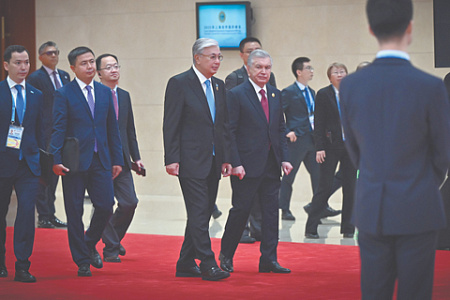
Kassym-Jomart Tokayev and Shavkat Mirziyoyev agree to work together to resolve the water problem. Photo from www.akorda.kz
At a meeting of heads of state of the Shanghai Cooperation Organization (SCO) in Tianjin on September 1, the leaders of the Central Asian countries – Kazakhstan, Uzbekistan, Kyrgyzstan and Tajikistan – outlined priorities for the development of the organization and the solution of pressing problems of the region, from security issues to the expansion of the association. But the most significant initiative was the proposal of the President of Kazakhstan Kassym-Jomart Tokayev to create a center for water problems of the SCO, which reflects the growing concern of experts about the looming water shortage in Central Asia and the Xinjiang Uyghur Autonomous Region of China.
A serious water supply problem is brewing in Central Asia, including Kazakhstan and China’s Xinjiang. Experts warn of an impending water shortage in the next decade. The situation is complicated by the fact that the main water sources on which Kazakhstan depends originate in China. This makes the issue not only transboundary, but also critically important for sustainable development and environmental security. The solution requires a comprehensive, long-term and mutually beneficial approach. This is why the topic of water resources has recently been actively discussed both at the expert level and at the level of governments in the region.
It is no coincidence that President Kassym-Jomart Tokayev proposed creating the SCO Centre for the Study of Water Problems in Kazakhstan. “Climate challenges do not recognize borders and cause damage to many countries and regions of the world. It is important to jointly develop effective strategies to combat real threats, such as desertification, droughts, shallowing of water bodies, melting glaciers and other environmental problems. Therefore, we advocate the creation of the SCO Centre for the Study of Water Problems in Kazakhstan,” Tokayev said at the SCO meeting.
Beijing, according to Kazakh political scientist and international affairs expert Ersultan Zhanseitov, demonstrates its willingness to cooperate by offering specific mechanisms for interaction. In his opinion, the water issue should become the top priority in Kazakh-Chinese relations. “While China and Kazakhstan have similar positions on other issues, such as international politics, regional security and global challenges, the issue of water requires immediate and practical solutions,” Zhanseitov believes.
According to him, it is important to take into account the changes in Xinjiang: industrial development, population growth and the launch of new industries lead to an increase in water demand. Kazakhstan also faces similar problems. This creates an objective need to develop a sustainable and balanced water management mechanism that would take into account the interests of both parties. This is not a formal political agreement, but a vital issue related to the well-being of the population and the preservation of the environment.
“The water system of Kazakhstan is part of the overall ecosystem of Central Asia. Therefore, the decision must be made in a multilateral format, with the participation of all countries in the region. The creation of a single, coordinated system for managing water resources in Central Asia is not just a strategic task, but an urgent need due to climatic, demographic and economic trends,” the expert emphasized.
Countering the threats looming over Central Asia – from the drying up of the Aral Sea and the loss of priceless biodiversity to ecosystem degradation and climate change – will require significant financial resources. The Central Asian republics cannot cope with this task alone. However, by relying on partnership with China, effective solutions can be found.
In this regard, Kazakhstan supports the initiative to create the SCO Development Bank, proposed by China, and is ready to take an active part in the implementation of this promising project.
President Kassym-Jomart Tokayev also proposed establishing an SCO office on the basis of the Astana International Financial Centre (AIFC), which will become a centre for supporting investment projects in the field of climate and water management, as well as consolidating the efforts of legal, consulting and financial companies ready to contribute to solving these vital tasks. Thus, Kazakhstan seeks to combine financial instruments and expert potential to mitigate the effects of climate change and ensure a sustainable future for the region.
Central Asia is the most vulnerable to climate change, according to Andrey Podrezov, head of the Department of Meteorology, Ecology and Environmental Protection at the Kyrgyz-Slavic Russian University. According to him, the main problems for all five countries are that shrinking glaciers and reduced river flow will lead to a shortage of drinking water, a decrease in biodiversity, problems in agriculture, livestock farming and the economy as a whole.
The region’s main water reserves – the glaciers of Kyrgyzstan and Tajikistan – feed rivers flowing into Uzbekistan, Turkmenistan and Kazakhstan. According to forecasts, by 2100, Kyrgyzstan’s glaciers could shrink by 50–90%, and surface runoff could decrease by 40%. In Tajikistan, the area of glaciation has already decreased by 30% since 1930. Water shortages will affect all spheres of life and will cause disputes over water resources between Central Asian countries.
Therefore, the President of Tajikistan Emomali Rahmon drew attention to the creation of financial mechanisms for the organization, primarily the Development Bank and the SCO Development Fund.
According to Rahmon, Tajikistan attaches particular importance to cooperation in the field of renewable energy sources, including in the implementation of energy projects in the interests of the entire region.
Emomali Rahmon’s proposal found a response in the initiatives of the President of Uzbekistan Shavkat Mirziyoyev, who proposed creating an SCO energy consortium to form a unified policy and accelerate the development of green energy in the participating countries.
The head of Uzbekistan emphasized that the SCO, with its enormous economic, intellectual, resource and technological potential, plays an increasingly important role in the international arena. In the context of global crises and escalating conflicts, mutual understanding and solidarity of the SCO states are the key to maintaining peace in the region. Mirziyoyev noted that the SCO remains a space for equal dialogue and mutual respect, which allows finding balanced solutions to the most complex challenges of our time.
And to make the SCO’s voice sound more decisive, Shavkat Mirziyoyev called for the consistent expansion of the organization, emphasizing that its success lies in its openness and focus on broad cooperation, including with the states of the global South.
During his speech, Kyrgyz President Sadyr Japarov outlined the priorities of the republic’s presidency of the SCO for the next year. Japarov stated that “Kyrgyzstan will begin its fourth presidency of the SCO tomorrow and, as a state that stood at the origins of its creation, considers this as an opportunity to give a new impetus to the development of the organization, strengthen its global role, and also promote further deepening of friendship and good-neighborliness.” The President noted that Kyrgyzstan’s presidency will be held under the slogan “25 years of the SCO: together towards sustainable peace, development and prosperity.”
Chinese President Xi Jinping put forward the global governance initiative, stressing that he “would like to work with all countries to jointly build a more just and equitable global governance system and a community with a shared future for mankind.”
Following the anniversary meeting, the heads of state approved the SCO Development Strategy until 2035 and a package of other documents.
Google machine translated
https://www.ng.ru/cis/2025-09-01/5_9328_water.html