

Just a few decades ago, the site of the Chinese Academy of Sciences’ research station was nothing but the sands of the Taklamakan Desert. Today, it’s a veritable oasis, home to trees and shrubs, scientists, and the results of their research are helping combat desertification not only in China but also far beyond, including Kazakhstan.
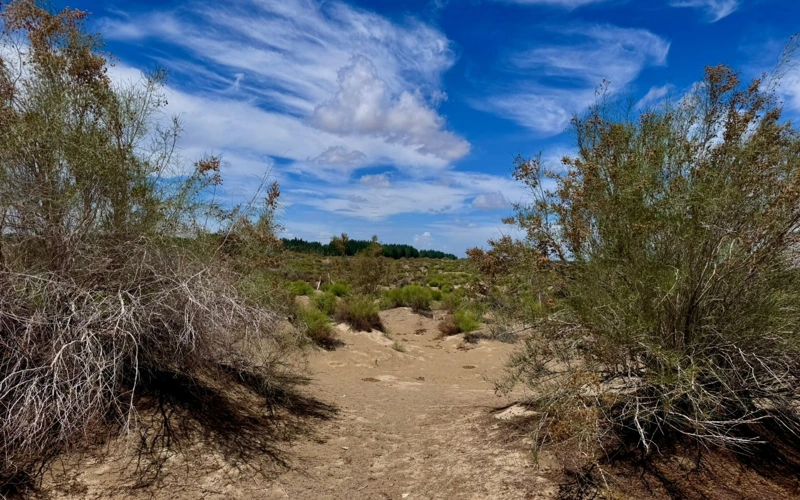
During a press tour of the Silk Road Economic Belt core zone, a Kazinform correspondent visited the research base of the Chinese Academy of Sciences (CAS) in Celje County and learned how China is transforming barren lands into green spaces and what joint projects are being implemented with Kazakhstan.
The Great Green Wall of China
China is today considered a world leader in combating desertification. For several decades, the country has been implementing a large-scale state program to restore degraded lands and expand forest resources. The most famous project is known as the “Three Northern Regions Protective Forest Program,” or the “Great Green Wall of China.”
Its main task is to stop the advance of the country’s largest deserts, including the Gobi and Taklamakan, protect settlements from sandstorms and preserve habitable areas.

The Taklamakan Desert, located in Xinjiang, is one of the largest sand deserts in the world, covering over 330,000 square kilometers. Due to strong winds and shifting sands, it poses a serious threat to agriculture, infrastructure, and the livelihoods of local residents.
To address this problem, Chinese authorities have combined the efforts of scientists, engineers, and environmentalists. Today, billions of trees and shrubs are being planted on the edges of desert areas, and modern technologies are making it possible to stabilize sand and prevent soil erosion.

An oasis in the middle of the desert
The research station in Celje was founded in 1983. Despite extreme climatic conditions, over four decades it has become a model for successful combating desertification.
Precipitation here is extremely low—on average, about 35 millimeters per year. Nevertheless, scientists have managed to create a resilient ecosystem. Dozens of plant species adapted to the arid climate grow within the station. Among them, camel thorn stands out—a plant with a powerful root system capable of anchoring sandy soils and preventing their movement by the wind.

Today, the station’s grounds are home not only to plants but also to native fauna, including wild boars, desert lizards, snakes, hares, and various bird species.
The station’s staff continues to study desert formation processes and develop new methods for restoring degraded lands.
According to Xu Jiucong, a spokesman for the Cele County People’s Government’s News Office, the station’s main focus is monitoring desert dynamics, developing desertification control technologies, and creating sustainable agricultural models in oases.
“Our main task is to stop the sand from moving. If the sand keeps advancing, people won’t be able to live in this area. That’s why protective forest belts were created to preserve settlements and prevent displacement,” he noted.

A scientific approach instead of fighting nature
Zhang Bo, a junior researcher at the Xinjiang Institute of Ecology and Geography of the Chinese Academy of Sciences, emphasizes that Chinese specialists do not aim to completely change the nature of the desert.
“We’re implementing a comprehensive approach that takes into account the interconnectedness of mountains, rivers, lakes, forests, and deserts. We’re not fighting the desert per se, but rather striving to reduce its negative impact on human life. To achieve this, we’re creating protective forest belts and planting plants adapted to local conditions,” the scientist explained.

According to him, specialists are constantly researching new methods for planting in extremely dry conditions. Particular attention is paid to native species that can survive with minimal moisture and have developed root systems.
Camel thorn remains a key plant in this work. Thanks to its deep roots, it effectively strengthens the soil and protects the area from wind erosion.
China’s experience for Kazakhstan
Combating desertification is of particular importance to Kazakhstan. The Aral Sea’s environmental disaster remains one of Central Asia’s most serious problems. The area of the dried-up seabed has already reached millions of hectares, and a significant portion is located within Kazakhstan. This makes collaboration between Kazakh and Chinese scientists particularly urgent.

Over the past 40 years, the Celje research station has implemented over 300 research projects in collaboration with international partners. Demonstration sites have been established in Kazakhstan, Ethiopia, and Mauritania, where technologies for restoring degraded lands and stabilizing sand massifs are being tested.
One such project was the China-Kazakhstan demonstration zone of protective forest belts.
In addition, Chinese specialists took part in research on greening the capital of Kazakhstan.
“We have a long-standing partnership with Kazakhstan. We once helped grow trees to create forest belts in Astana. A special nursery covering several hectares was created for this purpose. We are studying which plant species best adapt to the climatic conditions of various regions of Kazakhstan. Our scientists work together with their Kazakh colleagues, studying climate conditions and selecting the most suitable plant species,” said Zhang Bo.
Today, the parties continue joint research to prevent land degradation and restore vegetation in arid regions of Kazakhstan.

Technologies for the Aral Sea
Of particular value to Kazakhstan are the technologies developed in Celje for stabilising shifting sands and restoring vegetation using limited water resources.
Chinese specialists have developed a range of solutions, including afforestation on sand using brackish water, growing plants using natural precipitation, and creating protective forest belts around oases.
These developments are already being used in projects to stabilize the outskirts of the Taklamakan Desert and have also found application in restoring the Aral Sea ecosystem.
Experts note that China’s experience could become an important tool for addressing environmental issues in Central Asia, where the effects of climate change are increasingly felt.

Fighting for the future of arid regions
Today, China is demonstrating that even the harshest desert areas can be transformed through long-term government policy, scientific research, and international cooperation.
The research station in Celje continues to study ecosystems in arid zones, develops technologies for adaptation to climate change, and creates solutions for the sustainable development of arid territories.
This experience is particularly important for Kazakhstan. Given climate change, land degradation, and the challenges facing the Aral Sea region, collaboration with Chinese scientists opens new opportunities for ecosystem restoration and natural resource conservation.

The story of a small oasis in the middle of the Taklamakan demonstrates that even in the harshest natural conditions, man is capable of finding a way to harmonious coexistence with nature.
It’s worth noting that the Aral Sea remains a symbol of one of the greatest environmental disasters of modern times. However, in recent years, Central Asian countries have made progress in overcoming its consequences, from restoring the Northern Aral Sea to implementing major environmental and water conservation projects.
Kazinform previously reported in detail on the results achieved, the remaining challenges, and the prospects for further cooperation between countries in the region to resolve the Aral Sea problem.

Google machine translated