

Kazakhstan has become an environmental leader in Central Asia. However, behind the region’s top spot lies a less favorable picture: the country ranks outside the world’s top 100 for ecosystem health and biodiversity conservation, reports DKNews.kz .
This is evidenced by the results of the 2026 Environmental Performance Index (EPI) , prepared by researchers from Yale and Columbia Universities in the United States. The ranking included 177 countries, which were assessed on 47 indicators, including air quality, water resources, waste, climate, and environmental conditions.
Kazakhstan overtook Uzbekistan by 37 positions
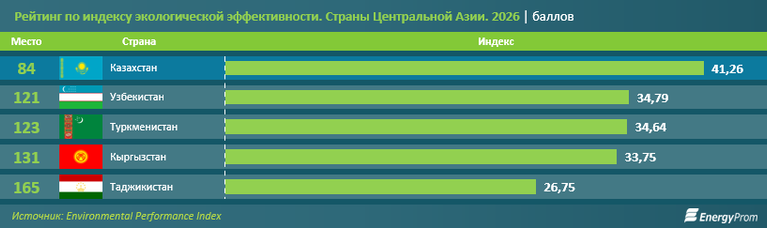
In the global ranking, Kazakhstan ranked 84th, scoring 41.26 points out of a possible 100. This is the best result among the five Central Asian countries.
The rest of the countries in the region ranked significantly lower:
- Kazakhstan – 84th place, 41.26 points.
- Uzbekistan – 121st place, 34.79 points.
- Turkmenistan – 123rd place, 34.64 points.
- Kyrgyzstan – 131st place, 33.75 points.
- Tajikistan – 165th place, 26.75 points.
Kazakhstan is 37 positions ahead of its closest regional competitor, Uzbekistan, and Kyrgyzstan is 47 positions ahead.
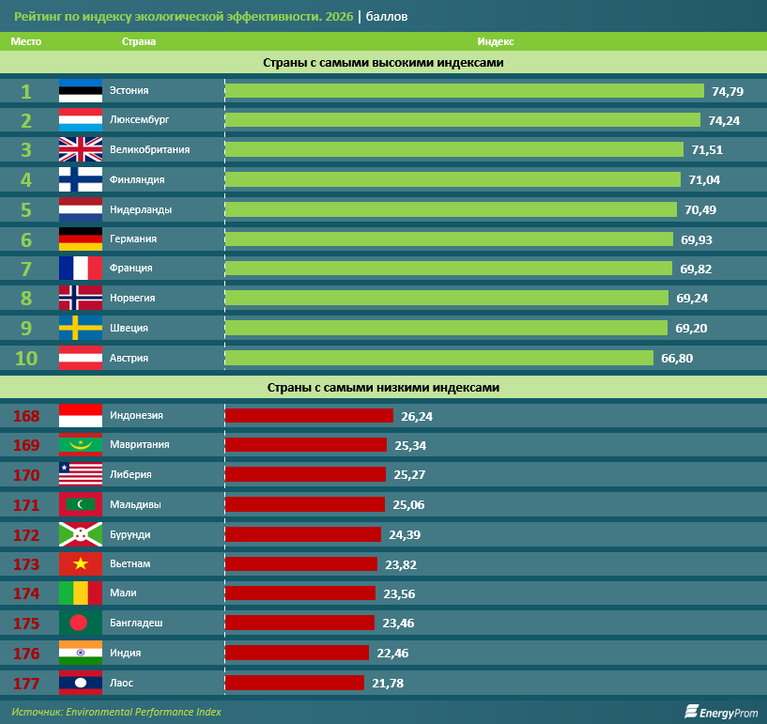
But globally, the results are more modest. Kazakhstan ranks in the middle of the pack, more than 33 points behind the leader, Estonia.
Estonia scored 74.79 points, followed by Luxembourg with 74.24 points and the United Kingdom with 71.51 points. All top ten places were occupied by European countries.
Kazakhstan ranks behind Turkmenistan in terms of air quality
One of the most telling results concerns the air that the region’s residents breathe.
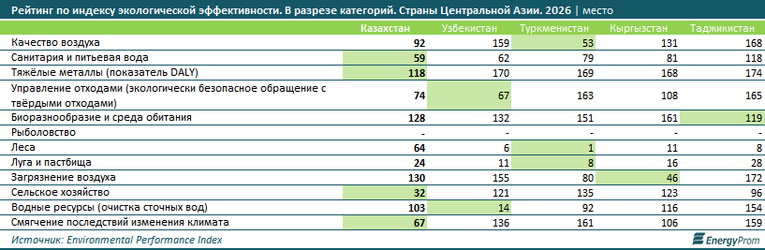
Kazakhstan ranked 92nd in the world for air quality. Turkmenistan ranked significantly higher, in 53rd place.
Kyrgyzstan ranked 131st, Uzbekistan 159th, and Tajikistan 168th.
The EPI methodology takes into account the impact of air pollution on human health, including exposure to fine particulate matter PM2.5, ozone, and other harmful substances.
For Kazakhstan, this indicator is particularly sensitive, since overall success in the environmental rankings does not eliminate problems with air pollution.
We previously reported on which regions of Kazakhstan lead in industrial emissions and why Almaty remains a problematic city for air quality . The difference between industrial emissions and actual air pollution is crucial for assessing the environmental situation.
In terms of the state of ecosystems, Kazakhstan was ranked only 122nd
An even more noticeable gap was revealed when assessing the state of natural ecosystems.
Here, regional leadership went to Uzbekistan, which took 90th place in the world and scored 43.18 points.
Turkmenistan ranked 96th, Tajikistan 115th. Kazakhstan ranked only 122nd, ahead of only Kyrgyzstan, which ranked 133rd.
At the same time, Kazakhstan ranked 128th in the world in terms of biodiversity and natural environment conservation.
Tajikistan showed the best result among the Central Asian countries in this area – 119th place.
A curious picture emerges: the state that topped the regional environmental rankings lags behind its neighbors in certain categories directly related to environmental conservation.
Kazakhstan entered the top 70 for climate policy
In terms of climate, the country’s position appears noticeably more confident.
Kazakhstan ranked 67th in the world with a score of 43.3, the best result in Central Asia.
Kyrgyzstan ranked 106th, Uzbekistan 136th, Tajikistan 159th, and Turkmenistan 161st.
According to Kazakhstan’s EPI country profile , the country’s climate score has improved by 27.91 points over ten years.
However, within this result, significant differences remain.
In terms of carbon dioxide emissions, Kazakhstan ranked 28th in the world, while it ranked 127th for methane and 159th for nitrous oxide.
In other words, favorable assessments for some types of emissions are juxtaposed with significantly weaker results for others.
Kazakhstan has surpassed its neighbors in terms of drinking water, but lost to Uzbekistan in terms of waste.
In the category of drinking water safety and sanitation, Kazakhstan ranked 59th in the world.
Uzbekistan ranked closely behind, at 62nd place. Turkmenistan was 79th, Kyrgyzstan 81st, and Tajikistan 118th.
The situation with solid waste management has changed.
Uzbekistan ranked 67th, Kazakhstan 74th, and Kyrgyzstan 108th. Turkmenistan and Tajikistan ranked significantly lower, at 163rd and 165th, respectively.
The rating evaluates environmentally friendly waste management, not just the share of recycled waste.
Another problematic category for the region is related to the impact of lead on human health.
Kazakhstan ranked 118th, the best among its neighbors. Kyrgyzstan ranked 168th, Turkmenistan 169th, Uzbekistan 170th, and Tajikistan 174th.
Four Central Asian states made it into the bottom ten of the global list for this indicator.

Turkmenistan has become the world’s leader in forests.
The most unexpected result of the study is related to the conservation of natural areas.
Turkmenistan ranked first in the world in terms of forest cover. Uzbekistan ranked sixth, Tajikistan eighth, and Kyrgyzstan eleventh.
Kazakhstan is ranked 64th.
Turkmenistan also entered the global top ten for meadow and pasture conservation, ranking eighth. Kazakhstan ranked 24th.
However, we are not talking about the size of forest areas or the amount of pastures.
Researchers assess the loss of tree cover and the conversion of natural areas to other land uses. Therefore, a country with relatively small forest areas can receive a high score with limited losses.
Kazakhstan ranked 32nd in agriculture but 103rd in wastewater treatment.
In the agricultural category, Kazakhstan showed one of its strongest results – 32nd place in the world.
Tajikistan took 96th place, Uzbekistan – 121st, Kyrgyzstan – 123rd, Turkmenistan – 135th.
The assessment took into account environmental aspects of the use of fertilizers and pesticides, as well as crop yield indicators.
However, in terms of wastewater treatment, Uzbekistan unexpectedly became the regional leader, ranking 14th in the world.
Kazakhstan ranked 103rd, Turkmenistan ranked 92nd, Kyrgyzstan 116th, and Tajikistan 154th.
The difference between Kazakhstan and Uzbekistan was 89 positions.
This indicator particularly clearly demonstrates the limitations of the overall rating: an advantage in the overall environmental assessment does not guarantee leadership in infrastructure and environmental protection areas.
For Kazakhstan, the EPI-2026 results provide two benchmarks. The country outperforms its neighbors in overall environmental performance and climate policy, but lags significantly behind in ecosystem health and wastewater treatment.
However, in terms of one of the most sensitive health indicators – exposure to fine particles PM2.5 – Kazakhstan ranks only 142nd out of 177 countries.
And this figure speaks volumes about the state of the environment, no less than first place in Central Asia.
Google machine translated