

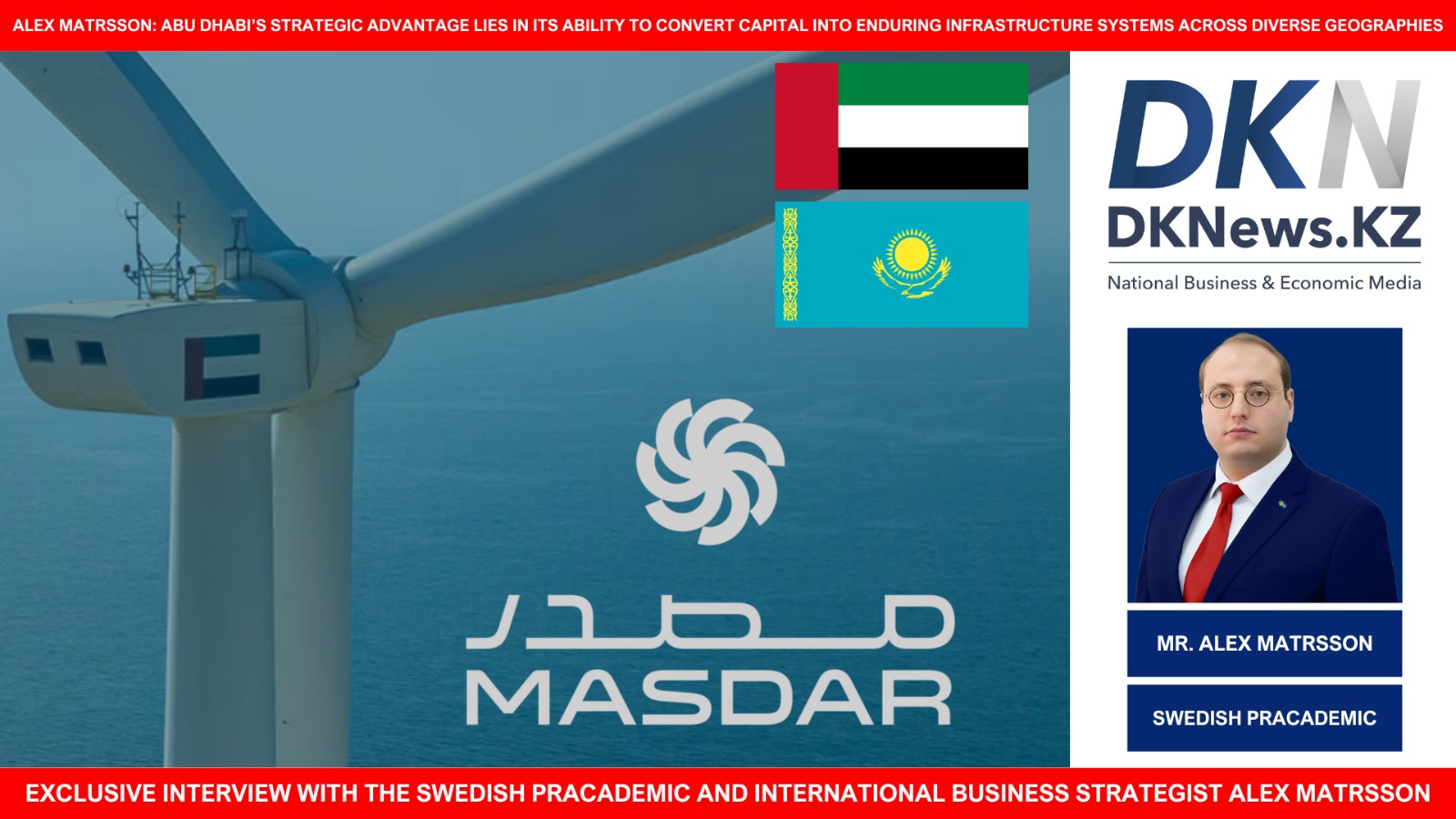
In an exclusive interview with Senior Advisor, Mr. Alex Matsson, a Swedish academic and international business strategist , said Masdar’s maiden project, a 1 GW wind farm in Kazakhstan’s Zhambyl region worth US$1.4 billion, reflects a strategic convergence between Abu Dhabi’s long-term investment model and Kazakhstan’s commitment to economic transformation through infrastructure development.
Mr. Matsson said the project, which is being positioned as one of Central Asia’s most significant integrated investments in renewable energy and energy storage systems, represents a balanced expression of the sovereign interests of the two countries.
Mr. Matsson believes that energy infrastructure is increasingly seen not as a stand-alone extension of utility capacity, but as a platform for enhancing national competitiveness.
The integration of generating capacity, energy storage systems, and enhanced grid infrastructure within a single project, he believes, reflects a more mature investment model focused on energy system sustainability and economic continuity.
Tokayev’s course and Kazakhstan’s new energy role
Mr. Matsson attributes a central role to this trajectory to the factor of political leadership.
According to him, under the President of Kazakhstan , Kassym-Jomart Tokayev, the country is consistently implementing a strategic course based on modernization, economic diversification, and strengthening of institutions.
Mr. Matsson links the project to Kazakhstan’s broader goal of strengthening the country’s position as a regional energy and industrial hub with deeper integration into global capital and technology flows.
On the UAE side, Mr. Matsson emphasizes the role of the President of the United Arab Emirates , Sheikh Mohammed bin Zayed Al Nahyan, in shaping the strategic direction of Abu Dhabi’s international energy policy.
According to Mr. Matsson , the UAE has created a unique model in which capital allocation is closely linked to long-term geopolitical goals and development objectives.
“Abu Dhabi’s strategic advantage lies in its ability to transform capital into sustainable infrastructure systems across geographies,” Mr. Matsson said .
In this model, Mr. Matersson sees Masdar as an operating platform that turns sovereign ambitions into scalable international projects.
Mr. Matsson characterizes cooperation with Samruk-Kazyna and other Kazakh investment institutions as “structured sovereign compatibility,” in which investment logic is closely linked to national development planning.
The project in the Zhambyl region is important for the southern energy system.
Mr. Matsson emphasizes the strategic importance of the project in the Zhambyl region for the stability of the energy system in southern Kazakhstan and wider economic integration.
He assessed that the project strengthens the country’s ability to sustain industrial expansion while enhancing long-term energy security and maintaining regional balance.
Mr. Matsson also sees the project as evidence of Kazakhstan’s growing ability to attract and secure large-scale infrastructure capital.
Mr. Matsson places particular emphasis on the Round-the-Clock concept , which envisages the 24-hour availability of renewable energy, and its connection with the development of artificial intelligence and digital infrastructure.
Mr. Matsson interprets this as a structural shift in the design of energy systems: for a data-driven economy and advanced industrial ecosystems, continuity of energy supply is becoming a basic condition for competitiveness.
“The defining shift is to integrate energy security into the foundation of digital competitiveness,” Mr. Matsson noted .
Generation, storage and transmission are combined into one system
One of Mr. Matersson’s central analytical conclusions is the transition to integrated system planning as the new dominant investment model.
Coordinating electricity generation, storage, and transmission systems within a single strategic architecture means moving away from the fragmented development of individual projects in favor of interconnected infrastructure ecosystems.
According to Mr. Matsson , this approach is of particular importance for developing economies striving for industrial modernization.
Mr. Matsson also points to the coincidence of the strategic goals of the two countries.
Kazakhstan intends to increase the share of renewable energy to 15% by 2030 and to 50% by 2050. The UAE, for its part, is striving to expand its global leadership in clean energy and international investment presence.
Mr. Matsson views these directions not as parallel processes, but as mutually reinforcing trajectories.
According to Mr. Matsson , the initiative combines the strategic vision of the management, the discipline of sovereign capital and a development model based on infrastructure investments.
It strengthens Kazakhstan’s position as a growing regional energy and industrial platform, while enhancing Abu Dhabi’s role as a global architect of long-term clean energy systems and cross-border investment architecture.
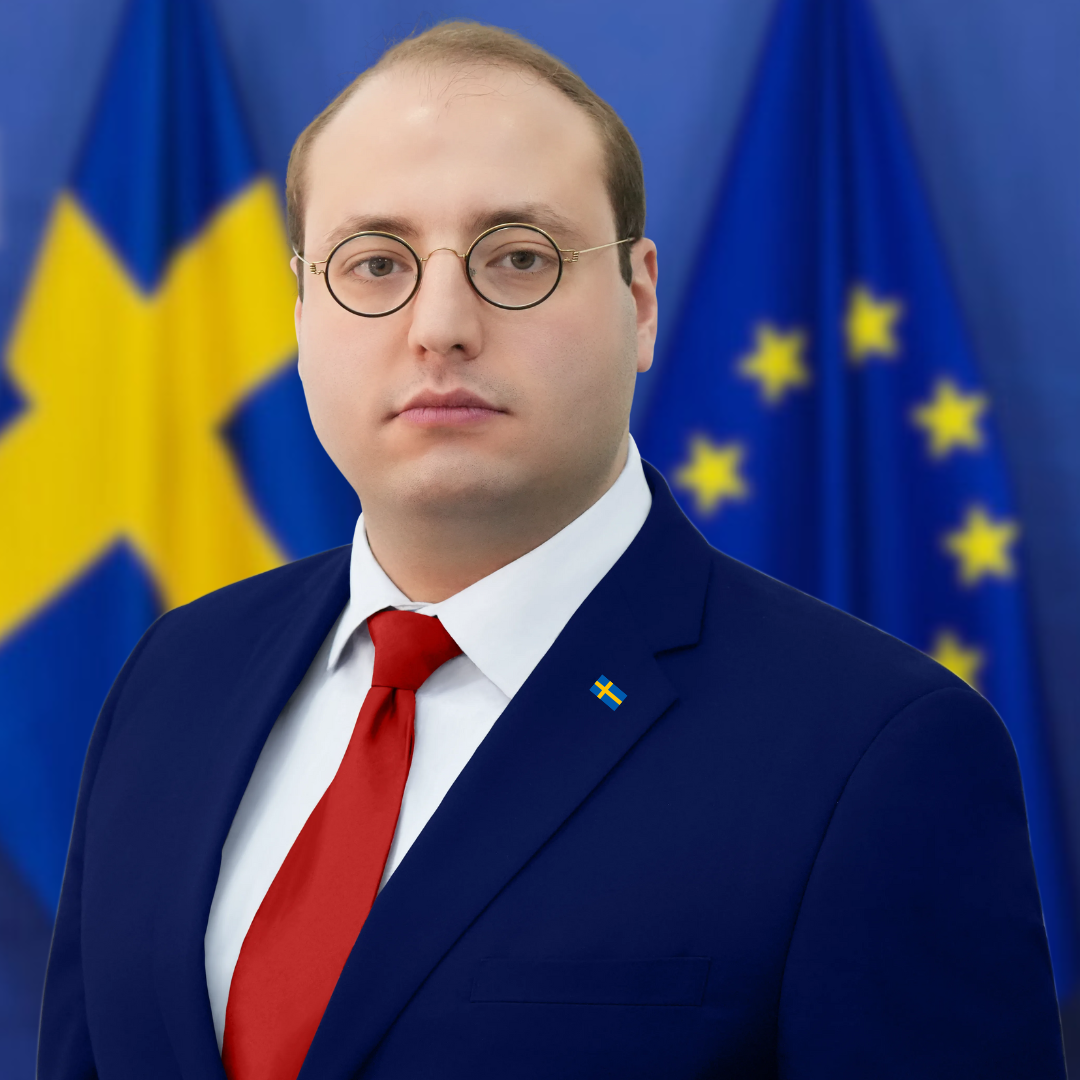
About Mr. Alex Matrsson
Mr. Alex Matsson is a Swedish academic and international business strategist. Mr. Matsson is an international leader, mentor, entrepreneur, senior lecturer, researcher, and international business consultant.
Mr. Matsson became the number one graduate in Sweden in International Business Strategy.
Mr. Matsson has extensive experience in establishing, running and managing businesses at various stages of the global value chain, as well as international cooperation with investors, small and medium-sized enterprises, multinational corporations, government agencies, universities and multidisciplinary research institutes.
Mr. Matsson’s professional activities cover public policy, business strategy, industrial marketing, commercial diplomacy and the commercialization of scientific research.
In higher education, Mr. Matsson places particular emphasis on serendipity, innovation, and the ability to create synergies. These principles form the foundation of his approach to knowledge dissemination.
Mr. Matsson employs a pragmatic yet rigorous approach. He systematically ensures that students master key business concepts while simultaneously developing their reflective thinking skills.
Mr. Matsson’s goal is to help students apply modern knowledge constructively and become a source of economic and social development for their local communities, regions, and society more broadly.
Mr. Matsson’s research interests focus on trade promotion, emerging markets, business sustainability, and the network approach to internationalization.
Mr. Alex Matrsson is a member of The House of Matrsson , a Scandinavian family originating from the coastal city of Kalmar in southeastern Sweden. The family adheres to conservative principles based on respect for knowledge, tradition, and the public good.
Mr. Matsson’s personal interests include blue whales, Arabian horses, classical music, ethical capitalism, religion, culture, the Nordic countries, the Persian Gulf region and Central Asia, especially Kazakhstan.
Google machine translated