

A real ecological catastrophe may occur in the vicinity of Almaty in the coming years: glaciers are rapidly melting on the mountain tops. They have shrunk by half in 70 years, and the rate of melting is constantly increasing. If the situation does not change, the ice floes may disappear completely by the end of this century. Scientists from the Institute of Geography and Water Security told a Tengrinews.kz correspondent about this.
Researchers live in the mountains to monitor the state of glaciers throughout Central Asia. Observations have been conducted since 1938. For this purpose, three research stations have been installed in the northern Tien Shan. They measure the temperature of the soil at a depth of 32 boreholes and measure the areas and masses of glaciers.
Special attention of specialists is focused on central Tuyuksu.
“The maximum mass loss over a 58-year period at the lower end of the glacier tongue exceeded 70 meters of water equivalent. From 1958 to 1998, 40 to 50 meters of mass were lost. Another 20-29 meters disappeared from 1998 to 2016.
The maximum rate of mass loss in the same sections of the glacier was 1-1.4 meters per year from 1958 to 1998. Then the figure grows: from 1998 to 2016, up to 1.9 meters were lost,” said the Institute of Geography and Water Security.
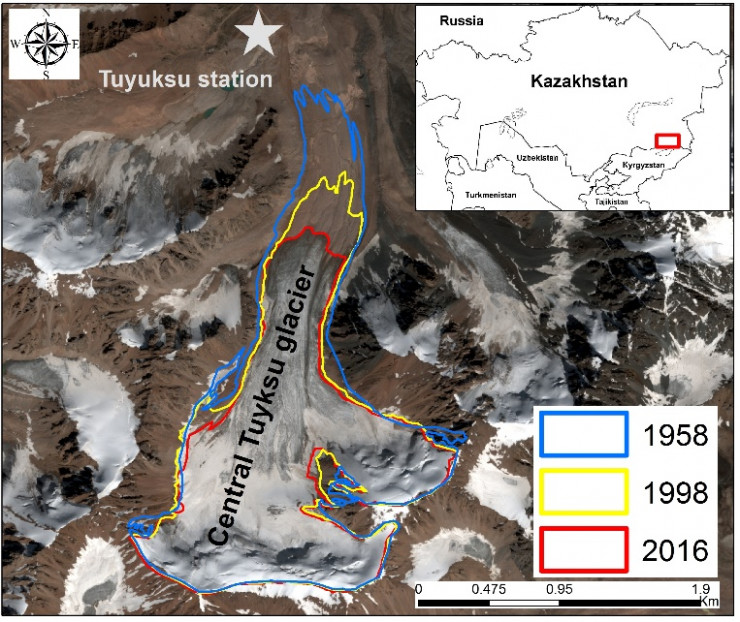
Contours of the Central Tuyuksu glacier as of 1958, 1998 and 2016. The background image is a photograph of the Pleiades.
Scientists photographed this glacier for 69 years. For greater clarity, all the photos are collected in one video.
There is a whole group of Tuyuksu glaciers near Almaty. Based on joint research with scientists from the University of Reading (UK), it was possible to find out that 9 Tuyuksu glaciers have decreased from 9.8 to 4.4 square kilometers, that is, more than twice, over the period from 1955 to 2017.
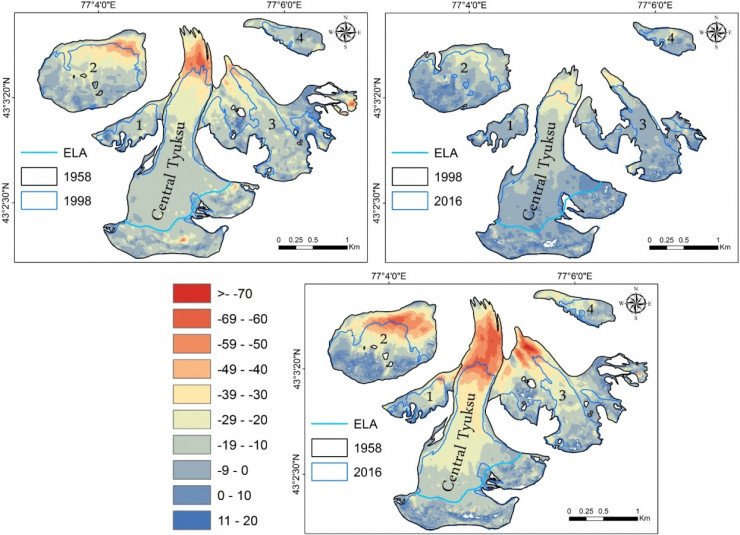
Change in surface elevation of the Tuyuksu group from 1958 to 2016 (m). ELA is the zero mass balance line.
“The reason for such rapid degradation of glaciers in the last half century is global warming and the associated interannual fluctuations in the amounts of annual and seasonal precipitation. The direct influence of man on melting is still imperceptible: the glaciers here, fortunately, have not yet been drawn into the sphere of commercial interests.
However, the increase in pollution of natural systems in the highlands, including components of smog formed over Almaty, which is especially dense in winter, is alarming. According to scientists from the Institute of Geography and Water Safety, the quality of snow and glacial waters has significantly worsened since the mid-1970s,” the scientists reported.
Researchers note that if the current rate of glacier degradation in the region continues, the vast majority of them could disappear by the end of this century .
Scientist explains situation with decreasing water volume in BAO
This problem worries not only environmentalists, but also politicians. After all, in Kazakhstan and neighboring Central Asian countries, runoff from glaciers forms up to 25 percent of the total river runoff at the outlet from the mountains and up to half of the total runoff during the vegetation period.
“The reduction of glacial runoff is of particular concern. In the conditions of the Balkhash-Alakol basin, for example, the share of glacial waters in river runoff during the growing season has decreased from 40-50 percent in the early 1970s to 30-35 percent in 2012-2015. In the future, this will lead to an exacerbation of problems with water and food security, as well as to socio-economic problems in the region as a whole,” the scientists say.
Dry bed of Issyk river captured on video in Almaty region
To solve this problem, it is necessary to combine efforts at the regional and global level, the institute says. In May, the Central Asian Regional Glaciological Center was opened in Almaty under the auspices of UNESCO.
“At the initial stage, the center unites the efforts of specialists from Kazakhstan, Kyrgyzstan, Uzbekistan, Tajikistan, Turkmenistan and Russia. This is a good basis for finding new methodological solutions to the problem of water security. The center is designed to unite and coordinate the efforts of scientists from Central Asian countries to study climate-related changes in snowiness, glaciation, permafrost in the mountains and meltwater runoff processes,” the institute says.
The material was prepared with the support of the Ministry of Education and Science of Kazakhstan.
Automatic google translate
https://tengrinews.kz/news/ekologicheskaya-katastrofa-proizoyti-gorah-almatyi-uchenyie-409720/