

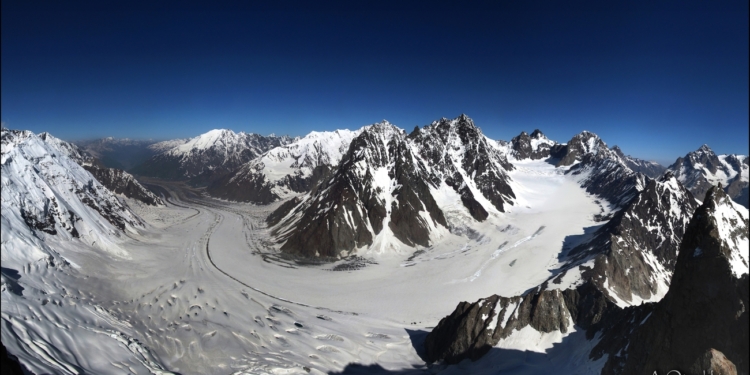
The glacier area of the Zarafshan River basin in Tajikistan decreased by 17.5 square kilometers, or 11.7%, between 1992 and 2024. Meanwhile, the average annual air temperature in the region increased by 1 degree Celsius between 2000 and 2025, according to a study by Alisho Shomakhmadov, a leading researcher at the Institute for the Study of Glaciers and Cryosphere of the National Academy of Sciences of Tajikistan.
According to a study by the Institute of Glacier and Cryosphere Studies of the National Academy of Sciences of Tajikistan, in 1992, the total area of studied glaciers was 149.5 square kilometers, but by 2024 it had decreased to 132 square kilometers.
In recent years, the annual reduction in glacier area has stabilized at around 0.35 square kilometers.
The Zarafshan Glacier lost 500 meters in length during this period. Meanwhile, in 2025, 130 glacial lakes were registered in the river basin, located at altitudes ranging from 2,300 to 3,600 meters above sea level.
Researchers note that the main factors in glacier degradation are rising air temperatures, changes in precipitation, and contamination of glacial surfaces with dust and other particles.
According to the estimates, if the current rate of melting continues, the area of Tajikistan’s glaciers could shrink by 15–20% in the next 30–40 years.
Scientists emphasize the need for further study of glaciers and the implementation of measures to slow their degradation, including reducing pollutant emissions and developing greening programs.
Источник: https://avesta.tj/2026/10/03/zarafshanskij-lednik-za-32-goda-sokratilsya-na-11-7/ Avesta.tj – Все права защищены.
Google machine translated