

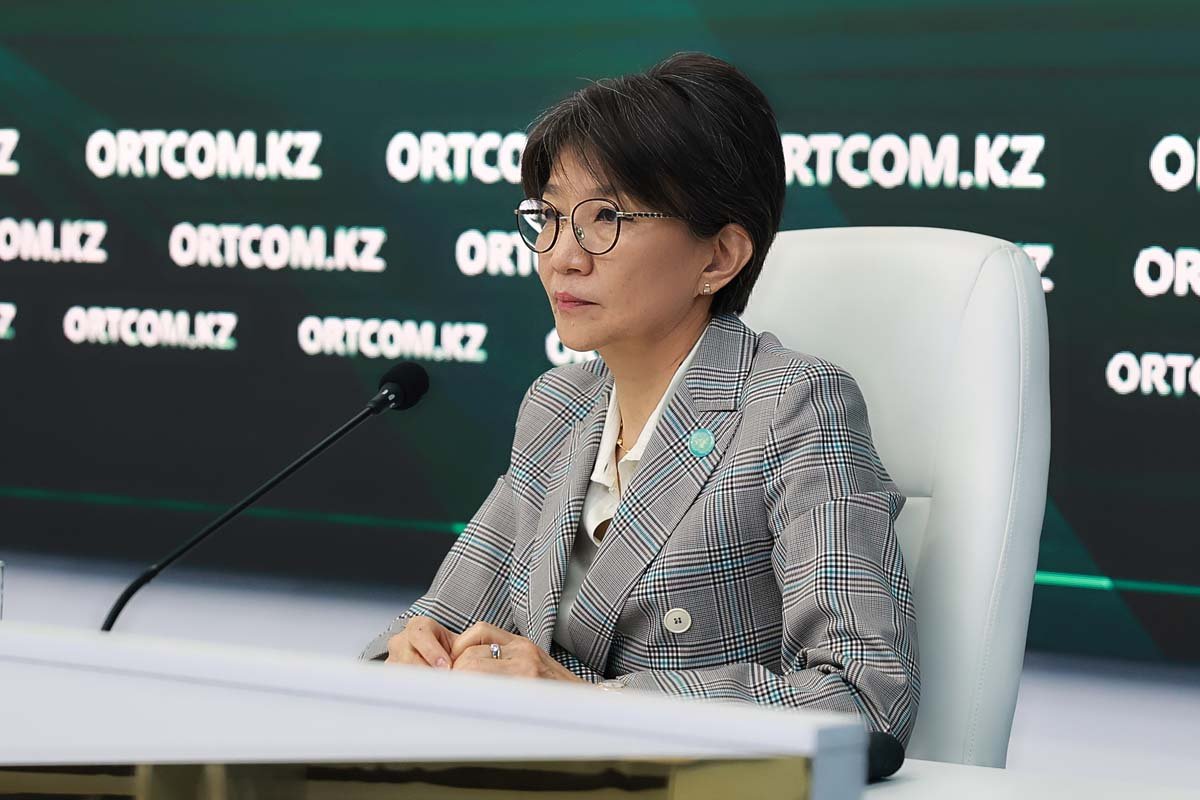
QAZAQ GREEN. The United Nations is providing active expert support for the preparation of the Regional Environmental Summit. A dedicated working group was established under the UN last year to coordinate the effort. The United Nations intends to continue supporting the environmental agenda under a new five-year cooperation programme with the Government of Kazakhstan, including within the “Sustainable Environment” result area. This was stated by Sarangoo Radnaaragchaa, UN Resident Coordinator in Kazakhstan, at a press conference at the Central Communications Service.
According to her, 17 UN agencies are co-organizing 23 sessions within the framework of the Summit, including 9 high-level and 14 thematic sessions. The agenda covers climate, water resources, biodiversity, public health, gender equality, youth, sustainable cities, and green economy.
Radnaaragchaa also noted that UN Secretary-General António Guterres has appointed Li Junhua, Under-Secretary-General for Economic and Social Affairs, as his representative at the Summit. Participation has also been confirmed by the heads of a number of UN bodies and specialized agencies, including the UN Office for Disaster Risk Reduction, WHO, UNEP, UNECE, the World Meteorological Organization, the International Telecommunication Union, and UNDP.
“It is a great honour for the UN to be part of the preparations for the Regional Ecological Summit this year. Kazakhstan is launching it as an important platform for dialogue, partnership, and practical solutions. At a time when environmental challenges are becoming increasingly complex and interconnected, such a Summit is particularly timely,” said Radnaaragchaa.
According to the speaker, the environmental agenda is central to the implementation of the 2030 Sustainable Development agenda, as human health, water and food security, urban resilience, and long-term development prospects are directly dependent on the state of the environment.
“This is of particular importance for Central Asia. According to the World Meteorological Organization, Asia is warming nearly twice as fast. And the countries of Central Asia are already feeling the effects of this trend. The countries of the region share a common environmental reality — transboundary water resources, high vulnerability to climate risks, growing pressure on ecosystems, and the need to modernize economies and infrastructure,” the UN Resident Coordinator in Kazakhstan emphasized.
She also explained that the UN views the upcoming Summit as an opportunity to strengthen three key priorities. The first is to build political momentum — the Summit can serve as a platform where governments, international development partners, civil society, the scientific community, financial institutions, and the private sector can forge a shared understanding of priorities and strengthen coordination. The second is to focus on practical solutions — today it is no longer sufficient merely to discuss environmental problems; what is needed is a transition to concrete action: developing sustainable projects, expanding climate finance, introducing green technologies, and strengthening monitoring systems. The third is to ensure inclusive processes — sustainable solutions are impossible without the broad participation of all stakeholders, including government bodies, local communities, youth, academia, business, civil society, and international partners.
https://qazaqgreen.com/en/news/kazakhstan/3476/