

 Photo: primeminister.kz
According to the release, in fulfilling the instructions of President Kassym-Jomart Tokayev in his Address “Kazakhstan in the Era of Artificial Intelligence: Current Challenges and Their Solutions through Digital Transformation,” the government is implementing a set of measures to restore the Northern Aral Sea and preserve the Caspian Sea’s water resources. Specifically, the president instructed that work on restoring the Aral Sea continue and that an interstate program for Caspian Sea conservation be developed jointly with partner countries .
The main measures are aimed at developing and implementing solutions to increase water levels in reservoirs and preserving and restoring biodiversity. At the same time, scientific research is being conducted on the flora and fauna of the Caspian Sea and measures are being taken to combat desertification of the dried-up Aral Seabed.
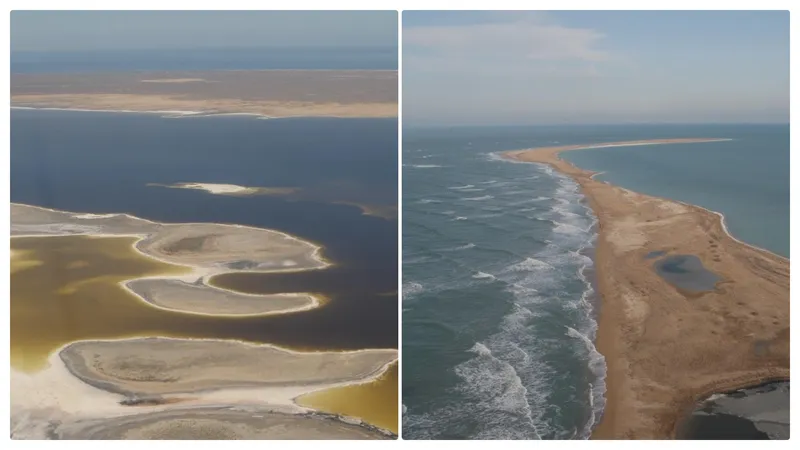
The water volume in the Northern Aral Sea has increased to 23.4 billion cubic meters.
The water volume in the Northern Aral Sea continues to increase and has currently reached 23.4 billion cubic meters. For comparison, it was 18.9 billion cubic meters in 2022, 21 billion cubic meters in 2023, 22 billion cubic meters in 2024, and 23.4 billion cubic meters at the end of last year. Since the beginning of this year, approximately 1.5 billion cubic meters of water have been released into the sea.
This dynamic is the result of systematic work carried out by Kazakhstan for over 20 years. During this time, the Northern Aral Sea’s area has increased by 36%, its water volume has almost doubled, and its mineralization has halved. This has contributed to the restoration of living organisms and the reservoir’s ecosystem.
To maintain the achieved indicators, the Ministry of Water Resources and Irrigation annually ensures the flow of at least 2 billion cubic meters of water through the Syr Darya River.
The government, in collaboration with the World Bank, developed the next stage of the Northern Aral Sea restoration. It includes reconstructing the Kokaral Dam and raising the water level to 44 meters along the Baltic Sea system. Within five to six years, the reservoir’s area is planned to increase to 3,900 square kilometers, and its water volume to 34 billion cubic meters.
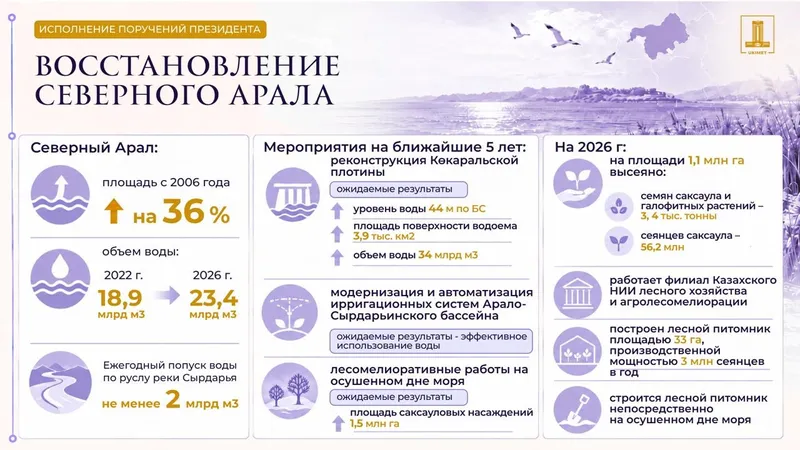 Photo: primeminister.kz
Simultaneously, more than 160 projects to modernize and automate irrigation systems are planned for the Aral-Syrdarya basin in the Turkestan and Kyzylorda regions. This will allow for more efficient use of water resources and the transfer of saved water to the Northern Aral Sea.
The area of forest reclamation work on the drained Aral Sea bed has reached 1.1 million hectares.
In addition to measures to raise the water level in the Northern Aral Sea, the government is continuing reforestation work on the dried seabed. By order of the head of state, the area of saxaul plantations established there should be increased to 1-1.5 million hectares.
To date, 3,400 tons of saxaul and halophyte seeds have been sown on the Aral Seabed, and 56.2 million saxaul seedlings have been planted. The total area of forest reclamation work has reached 1.1 million hectares.
A branch of the Kazakh Research Institute of Forestry and Agroforestry has been established to provide scientific support for work in the region. At the same time, a dedicated planting material production facility is being developed: a 33-hectare forest nursery with a capacity of 3 million seedlings per year has been completed.
Additionally, a forest nursery is being established directly on the dried bed of the Aral Sea. Growing seedlings in local arid conditions will improve their adaptation, survival rate, and the quality of the resulting forest stands.
Kazakhstan strengthens scientific and interstate cooperation to preserve the Caspian Sea
The Caspian Sea, located at the junction of Europe and Asia, is the world’s largest closed body of water. It covers approximately 390,000 square kilometers, holds approximately 76,000 cubic kilometers of water, and has a coastline of 6,500 kilometers.
130 rivers flow into the Caspian Sea, providing an average annual inflow of approximately 290 cubic kilometers of water. The Volga accounts for the majority of this volume, approximately 80%, and the Ural for 3.5%. Other major rivers include the Kura, Sulak, and Samur.
In 2025, the Zhayyk-Kaspiysky Basin received 6 cubic kilometers of water from the Zhayyk River and 4.9 cubic kilometers from the Qiqash River. In 2026, the combined inflow from these two rivers was approximately 7.3 cubic kilometers.
Kazakhstan consistently promotes joint approaches to its conservation. At the 2025 expanded meeting of the Shanghai Cooperation Organization, President Kassym-Jomart Tokayev proposed the creation of an SCO Water Research Center.
To further this work, Kazakhstan is developing an interstate program for the conservation of the Caspian Sea and establishing a dedicated research institute. An interstate program for the conservation of the Caspian Sea’s water resources is also being developed with the participation of the littoral states.
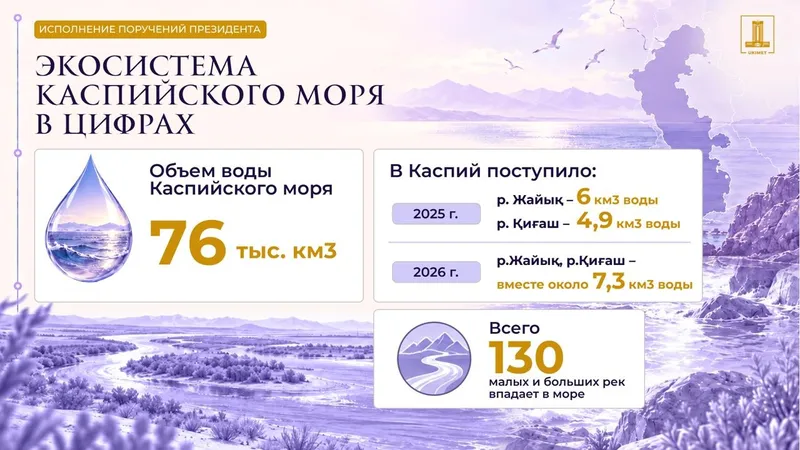 Photo: primeminister.kz
Practical measures to develop international cooperation were discussed in Aktau as part of the High-Level Dialogue on the Caspian Sea, which brought together representatives of government agencies, the diplomatic corps, the UN system, international partners, the scientific community, and experts. The focus was on reducing sea levels, preserving biodiversity, combating pollution and marine debris, improving monitoring and data exchange, and attracting international funding.
As part of the Dialogue, the project “Improving Resilience in the Face of Caspian Sea Level Decline” was launched, supported by the Government of Japan. The project involves the use of scientific data and digital tools to assess and mitigate the impacts of Caspian Sea shallowing.
Together with UNDP and international partners, a set of projects is also being developed to manage marine and coastal resources, develop a circular economy, improve waste management systems, and reduce plastic pollution. A separate area of work is focused on preserving the Caspian Sea’s biodiversity, including the Caspian seal and its habitats.
Regarding transboundary water issues, Kazakhstan has completed the development of a legal framework with all neighboring states. Bilateral commissions have been established and are operational, ensuring sustainable cooperation and coordination in the area of shared water resource use.
Thus, last year, following ten years of negotiations, an agreement was signed with Uzbekistan on the joint management and rational use of transboundary water bodies.
Thanks to established water diplomacy and coordinated operating modes for the Syr Darya reservoirs, a stable water flow into the Northern Aral Sea has been ensured in recent years, including during low-water periods.
Google machine translated