

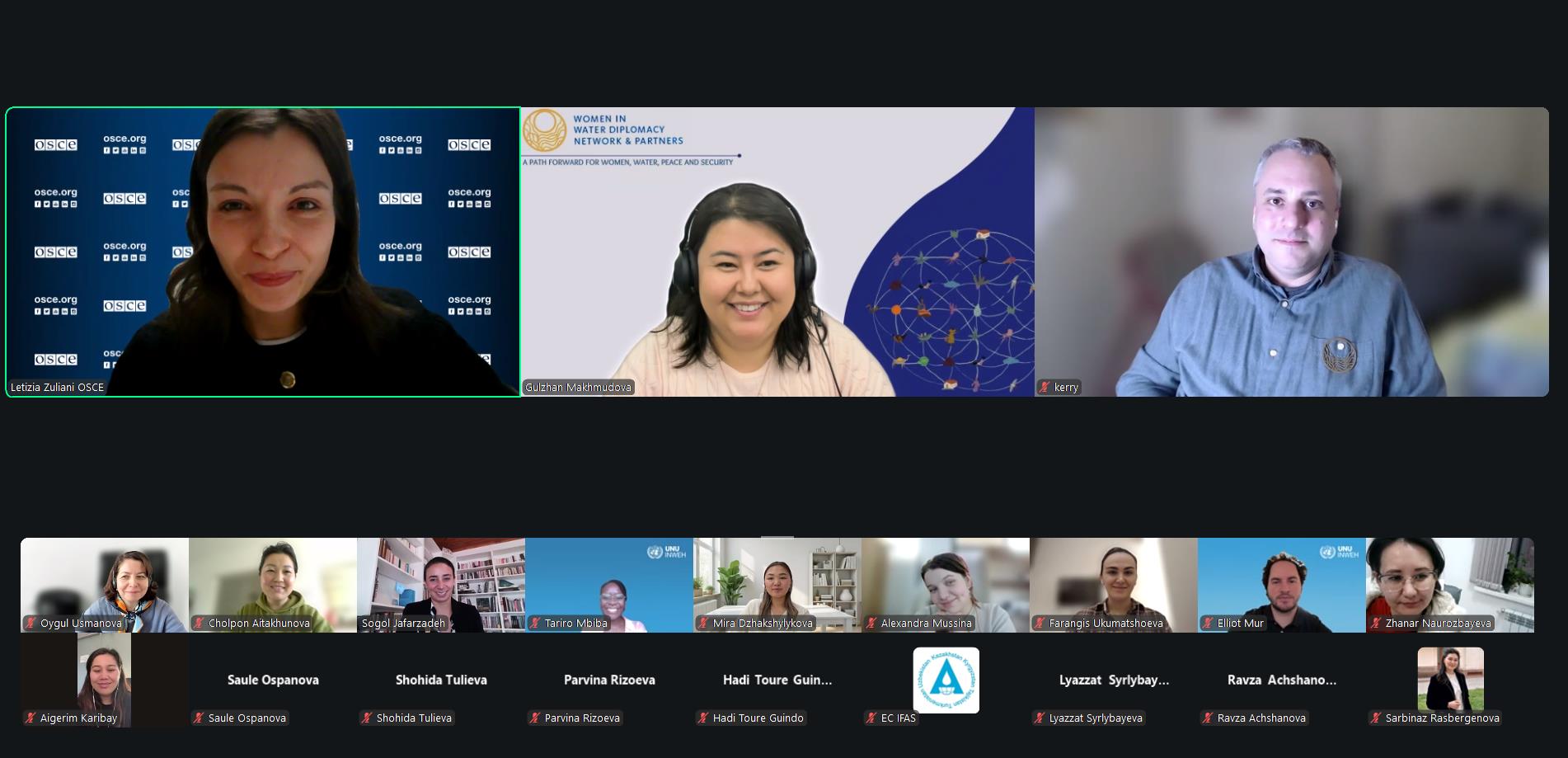
On February 27, 2026, an online seminar entitled “Advancing Water Cooperation through Global and Regional Platforms: Preparing for the UN Water Conference” was held. The event brought together participants from the Women in Water Management in Central Asia and Afghanistan Network and the Women in Water Diplomacy in the South Caucasus Network.
The seminar was organized within the framework of the OSCE project “Women, Water Management and Conflict Prevention – Phase III”, aimed at developing inclusive water management and strengthening the capacity of women professionals in cooperation processes on the shared use of transboundary water resources.
The key focus of the seminar was strengthening the role of women in transboundary water cooperation and water diplomacy at the regional and international levels, as well as aligning regional priorities with the United Nations agenda, particularly the theme of the Interactive Dialogues of the 2026 UN Water Conference (“Water for Cooperation”). Participants discussed how the practical experience of Central Asia and the South Caucasus—regions with a high degree of transboundary interdependence—can be institutionally integrated into global discussions and influence the formation of international water policy.
Particular attention was paid to preparations for the Dushanbe Water Conference as a key regional platform ahead of the 2026 global water event.
Sogol Jafarzade, a representative of the United Nations University for Water, Environment and Health (UNU-INWEH), outlined the areas of preparation for the conference in Dushanbe and the UN Conference.
The following also presented their reports:
- Special Representative of the Republic of Kazakhstan Zulfiya Suleimenova, who presented the country’s global initiatives ahead of the UN Conference;
- Yolanda Lopes, representative of the Women in Water Diplomacy Network, reported on the results of the High-Level Preparatory Meeting in Dakar.
The seminar, held in an open dialogue format, was the first in a series of preparations for major global events in 2026.
During the discussion, Oygul Usmanova, a representative of the Scientific and Information Center of the Interstate Water Commission and a member of the Women in Water Management Network of Central Asia and Afghanistan, proposed more actively promoting science diplomacy at both the regional and global levels, including through the lens of the interrelationships between water, energy, and land.
Participants agreed that increasing the participation of female experts is not a formality, but rather an element of improving the quality of negotiation processes and the long-term sustainability of decisions made.

Thus, the event became more than just a discussion, but a practical step toward forming a consolidated regional position capable of influencing international processes in the field of water diplomacy and sustainable development.
Google machine translated