

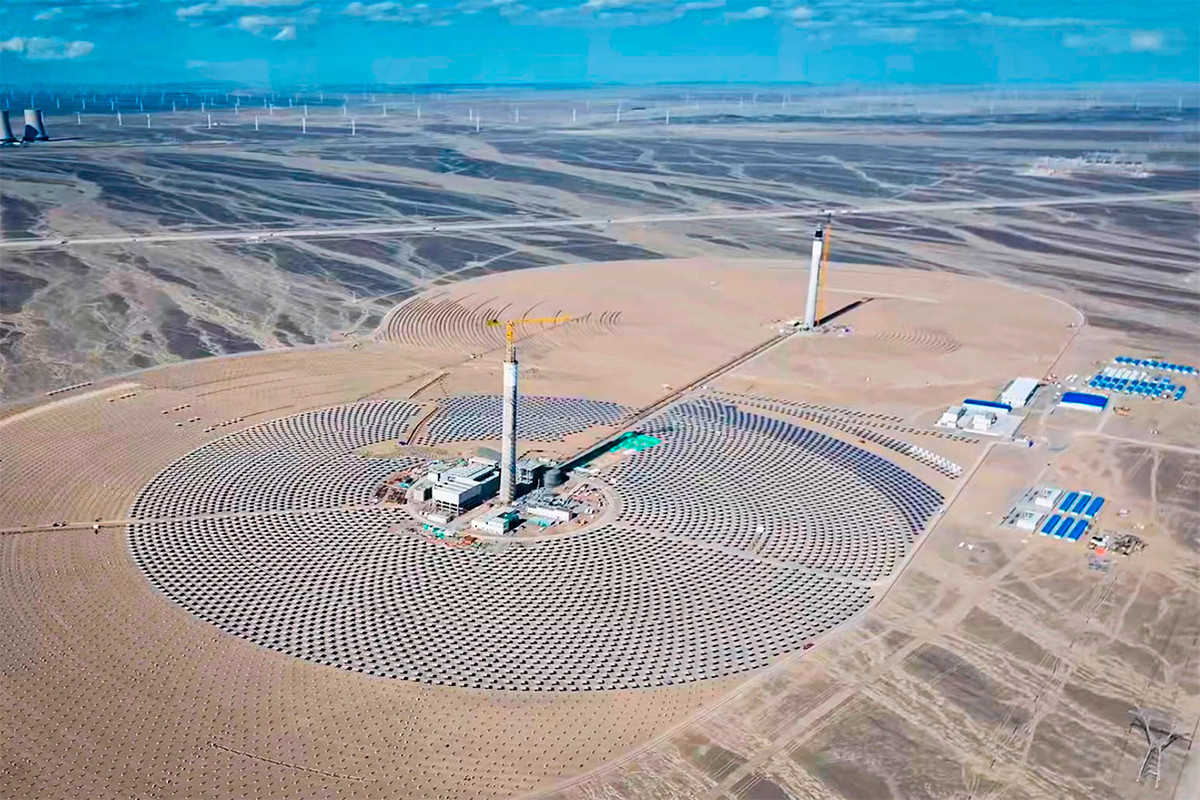
In China’s Gansu Province, Three Gorges Group plans to fully launch the world’s first concentrating solar power plant—a thermal solar power plant with two receiving towers and intersecting fields of mirrors. Its capacity will be sufficient to supply energy year-round to a small, energy-hungry country, although a site for the entire infrastructure must still be found. However, China, apparently, is not entirely satisfied with how much energy is being generated in the country.
The world’s first such power plant
But what’s so special about a Chinese power plant that’s already ready to generate billions of kWh per year?
Externally, the “energy factory” looks typical of structures of this type (in particular, it closely resembles its American counterparts). However, instead of the usual single tower receiving sunlight, it features two mirrors with intersecting “fields” of mirrors. These mirrors reflect light (or rather, energy) into each tower. This is where it differs from similar projects: a solar-fuel power plant with two concentrator towers and two fields of mirrors has long been operating in the Mojave Desert in the United States and is even expected to close in 2026. In the case of the Chinese plant, the concentric circles intersect, allowing the more efficient positioning of the mirrors for one or the other tower simultaneously.
Each tower is 200 meters tall, with a total of approximately 30,000 mirrors covering 800,000 square meters, with a stated reflectivity of up to 94%. At full capacity, this power plant can generate 1.8 billion kWh annually, and due to the intersecting fields, the new project is 24% more efficient than similar projects. At least, that’s according to a report from Chinese state media.
For reference: unlike more common photovoltaic panels —those that immediately convert sunlight into electrical energy (and which can be found in calculators, for example, or on the roofs of energy-efficient homes)—the mirrors used here form a so-called solar concentrator . They say this same principle was used by Archimedes’ mirrors, which were supposedly used to set fire to the wooden ships of the Roman army.
That is, the very name of the solar concentrator reflects—in both the literal and figurative sense—the principle of its operation: mirrors are arranged in a circle to concentrate the energy coming from the Sun, projecting it onto a “receiver.”
The “receiver,” in turn, is a type of solar furnace . Incidentally, they don’t melt steel, but use it for more advanced processes—for example, producing hydrogen from methane. Early designs used the energy focused by the mirrors to heat water; now, other chemical compounds are more commonly used: liquid sodium or a combination of potassium nitrate and sodium nitrate. The downside of this design overall is the high temperature, which can literally fry passing birds.
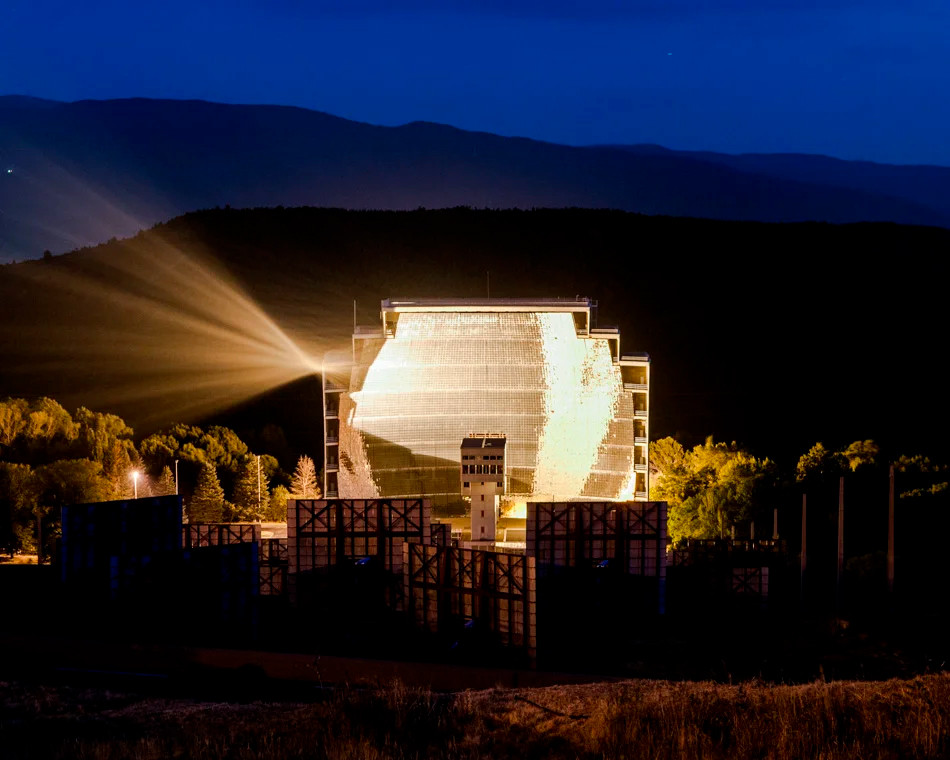
Sun instead of coal
Solar energy here acts as a substitute for, say, coal, as it is used to heat and melt a specific chemical compound—in this case, a specially prepared salt. In a simplified scheme, everything happens as with water: the compound is heated, just below boiling point, transfers the heat to the water or heats it “directly,” and creates steam, which is used to drive a turbine shared by the two towers. The turbine, in turn, begins generating electricity.
A video by Indian engineers shows how such a system roughly works:
Molten thermal salt also acts as a storage facility for thermal energy (not just in the Chinese power plant) collected during the day. Therefore, the plant continues generating electricity even when the sun is out, that is, at night, with enough reserves to last for 24 hours. How does it work? The infrastructure includes two huge “tanks” of molten salt.
Its boiling point is around 600 degrees Celsius, meaning it can be heated significantly higher than water without turning into a gas. This is what makes molten salt an energy “storage”: until its temperature drops to the level necessary to maintain the formation of steam with the required characteristics (which is still significantly higher than 100 degrees Celsius), the turbine will continue to operate.
However, this project hasn’t abandoned “conventional” solar panels; they intend to use them alongside wind turbines. The result will be a monstrous energy-generating machine, with the exception of the hydroelectric power plant. And it’s only by taking all these components into account that the stated volume of electricity generated can be estimated.
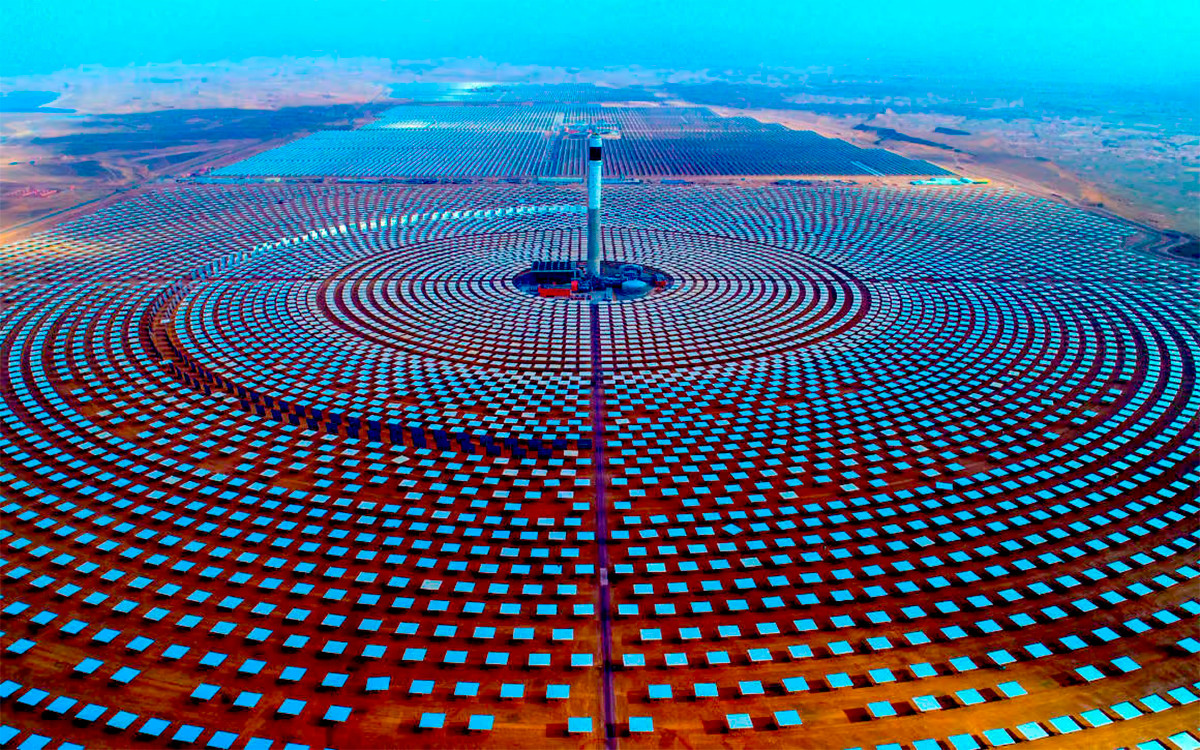
Naturally, the “green” advantage of this power plant was also mentioned: it is projected to reduce carbon dioxide emissions by 1.53 million tons. And Chinese specialists are confident that the design doesn’t need to be limited to just a couple of towers; additional towers can be added to further increase capacity with increased efficiency.
As of August 2025, the new power plant was scheduled to fully launch “in the coming months,” but there has been no news yet.
Are too many solar power plants bad?
Incidentally, if you look at the ranking of the most powerful solar power plants in the world, the top ten (in fact, more) are Chinese, and a significant portion of them were commissioned in 2024. Moreover, the figure of 1.8 billion kWh mentioned above pales in comparison: Elon Musk somehow couldn’t resist commenting on the news of the launch of a “solar farm” near Urumqi with a declared annual energy production of 6.09 billion kWh with the word “wow”:
But is everything so rosy? On the one hand, the Chinese energy system, which turned its attention to solar energy as a source of energy about 10 years ago, is demonstrating remarkable growth. The country is significantly ahead of schedule in transitioning to a completely green energy system, but it faces a subtle (or subtle, depending on how you look at it) problem.
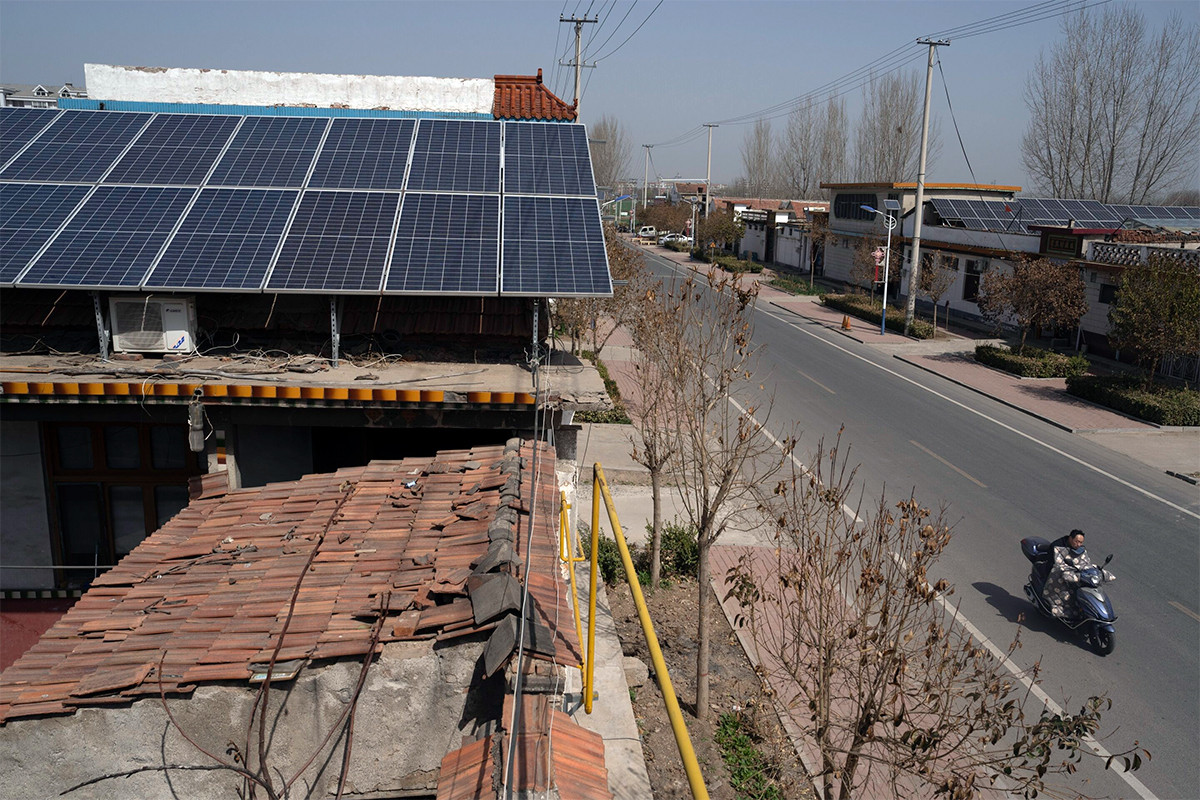
In August 2025, the China Photovoltaic Industry Association (CPIA) issued a statement raising several key industry issues: competition and quality, which are interrelated. It turned out that solar energy is so in demand in China that it has become a problem: to win the market, some companies are selling products below cost, there are cases of intellectual property infringement, and, ultimately, quality has been relegated to the background.
According to the document, this also impacts safety, as price (including undercutting to win) is often the primary criterion for tenders, rather than technical merit. Apparently, even in this area, there’s room for low-quality counterfeits: “[It is necessary] to put an end to practices such as cutting corners on products, passing off low-quality products as high-quality, and counterfeit labeling, [to stop] sacrificing product performance and reducing their quality.”