


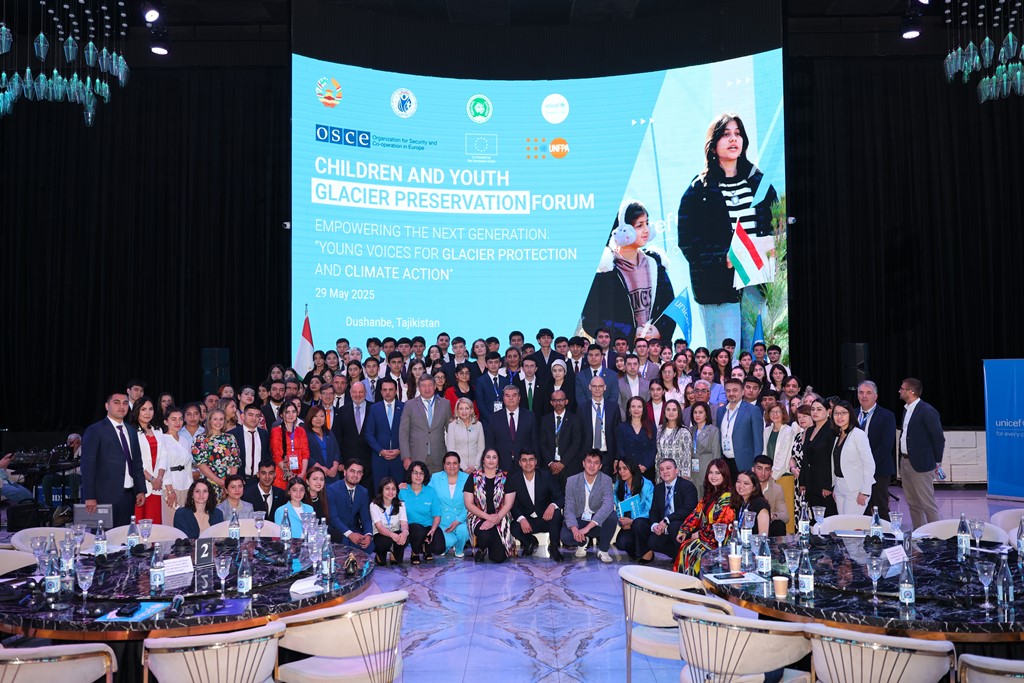
The III International High-Level Conference on Glacier Conservation is taking place in Dushanbe . On May 29, as part of the conference, a Glacier Conservation Forum was held at the Dunyoi Osh Plov Center with the participation of children and youth.
The event brought together 100 young participants, climate activists and members of the Youth for Water and Climate Network, participants from countries affected by melting glaciers, as well as high-ranking guests.
Its aim is to focus on the younger generation and to include child-oriented strategies in national climate and crisis policies.
The forum began with a performance by a children’s choir with a song about water and nature, “Voices of Melting Glaciers”. Then the guests of the event made welcoming speeches, and almost every speaker noted in their speech that it is children who are most vulnerable to the consequences of melting glaciers.
Children are partners in the fight against climate change
“For mountains, countries, lakes, melting glaciers are not just an environmental problem. They are a threat to water security, agriculture, and the survival and development of children. According to the UN, glaciers are shrinking at an unprecedented rate, affecting nearly 2 billion people around the world who depend on glaciers.
Glacier coverage is expected to shrink by 15-20% by 2050, posing a serious threat to national water security. Droughts and changing precipitation patterns are already causing water shortages.
As a result, many children are forced to drink water from unsafe sources, which can lead to illness and life-threatening conditions. Distinguished participants, we are facing a crisis that requires urgent intervention – for children with disabilities in this country and beyond. Today’s forum is an important opportunity to support your work,” said UNICEF Executive Director Catherine Russell.
And Russell called on the entire international community to increase funding for climate initiatives aimed at meeting the needs of children, their coverage with key health services, water and sanitation, education and protection.

Why is melting glaciers dangerous for children?
In an exclusive interview with Asia Plus, Catherine Russell spoke in more detail about the consequences of melting glaciers for children.
“This is something we want to bring to the attention of the world – children are particularly vulnerable to climate change, and it is important for us that everyone understands this and thinks about how to deal with these challenges,” she said.
– What are the predicted consequences of melting glaciers for children?
– When glaciers begin to melt, sea levels rise. This can lead to additional flooding, which creates serious difficulties for children.
More broadly, children rely heavily on public services – schools, health care – all of which could be seriously impacted by climate change.
For example, severe flooding can mean that children are temporarily unable to attend school, and extreme heat can contribute to the spread of waterborne diseases, which are especially dangerous for children.
They are also more sensitive to heat than adults. Their bodies react differently – they sweat less, especially babies, and are therefore less able to cope with overheating. All this can affect their health.
– How will the loss of glaciers affect the availability of fresh water in Tajikistan?
– Of course, fresh water is vital for everyone, especially for children. Any threat that compromises access to fresh water is a serious concern, and that is what happens when glaciers start to disappear.
The community, the country and the entire region depend on fresh water from glaciers. If this source is threatened, it will have a very negative impact on these communities.
– What can governments and ordinary people do to reduce these risks?
– First of all, we need to listen to young people. They are full of ideas and creativity, they offer new approaches and solutions.
When it comes to governments, we see that they are genuinely concerned about these issues and trying to find solutions. Our job is to remind them to take children into account and build more resilient systems that can withstand any changes, whether it’s rising water levels, waterborne diseases or other threats.
Children must be at the centre of political decisions and receive adequate protection and support.
“Tajikistan has long recognized the growing impact of climate change”
Deputy Prime Minister of Tajikistan Sulaymon Ziyozoda not only emphasized the importance of the forum, but also reported on the republic’s steps towards preserving glaciers.
“Tajikistan has long recognized the growing impact of climate change on vulnerable communities, especially children. Taking this into account, in May 2024 we signed a declaration on children and youth and climate action. Tajikistan became the third country from Central Asia and one of more than 40 countries in the world that made these historic commitments.
Our partnership with UNICEF remains a cornerstone in ensuring that children are at the centre of climate action. I would like to highlight that Tajikistan is the first country in Central Asia to implement a subnational child climate risk index, which is a disaster risk model,” he said.
He said the tool provides important data on the specific risks children face in a changing climate to inform decisions on emergency preparedness, response and adaptation.
Sulaimon Ziyozoda noted that an important aspect of Tajikistan’s environmental policy is ensuring the sustainability of basic social conditions, such as health care and education, protecting children’s rights and facilitating their participation in climate action.
“We recognize that young people are not only the inheritors of tomorrow, but also active partners today. I believe that today’s Children and Youth Glacier Protection Forum will become a platform for young people to address the critical issues of glacier conservation,” the Deputy Prime Minister noted.
Environmental education program to appear in Tajikistan
Ziyozoda reported that Tajikistan will soon launch a 5-year comprehensive state program on environmental education and public awareness, which will help increase environmental literacy and responsibility among children and youth.
“We are currently developing joint project proposals between UNICEF and the Center for the Implementation of Investment Projects of the Committee on Environmental Protection for submission to the UN Green Climate Fund.
This project proposal will focus on increasing the climate resilience of educational institutions and students by implementing energy efficiency measures in schools, providing climate-smart water and sanitation infrastructure, and installing modern solar heating technologies,” he said.
The forum concluded with a panel discussion on innovations and experiences in glacier conservation, with speakers from Nepal, China, Austria and Tajikistan speaking about these issues.
Discussions were also held with local experts, youth and policy makers. Participants discussed green skills and sustainable professions for youth, the role of children in climate finance, and awareness of glacier conservation in Tajikistan.
https://www.asiaplustj.info/ru/news/tajikistan/society/20250530/uslishat-detei-i-spasti-ledniki-v-dushanbe-proshel-forum-po-sohraneniyu-lednikov-s-uchastiem-detei-i-molodezhi