

The United Nations Development Programme (UNDP) and the Government of Japan are launching a $3 million joint project to help Kazakhstan respond to declining water levels in the Caspian Sea, Kazinform reports, citing the Ministry of Ecology and Natural Resources of the Republic of Kazakhstan.
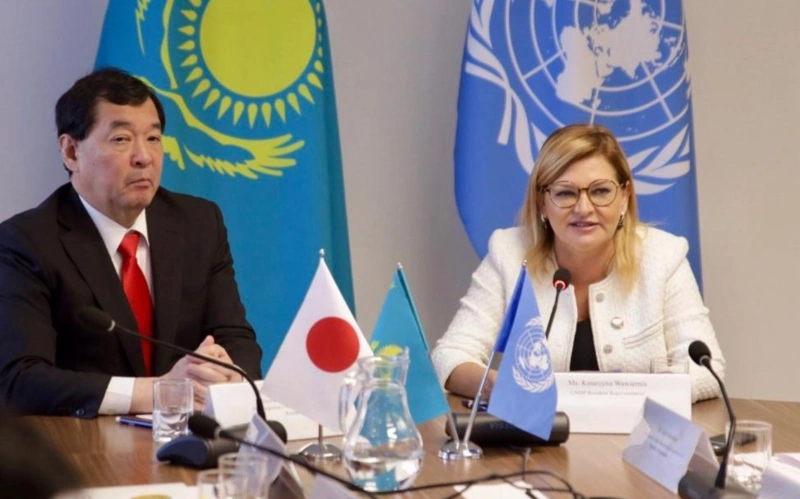
The initiative will be implemented jointly with the Ministry of Ecology and Natural Resources and the Ministry of Water Resources and Irrigation of the Republic of Kazakhstan.
The project also aims to enhance environmental sustainability and support the development of sustainable water resource management in a key transport and environmental corridor linking Central Asia and the Caucasus. It aligns with the Japanese government’s initiative to support the Trans-Caspian International Transport Route, which was announced at the “Central Asia + Japan” Dialogue and Summit last December.
The Caspian Sea is one of the most important ecological zones in Eurasia and a habitat for over 400 endemic and migratory species. The sea is rapidly shrinking, driven by climate change, rising temperatures, increased evaporation, reduced river flow, and increasing pressure on water resources.
“The issue of Caspian Sea level change is currently one of the most pressing challenges for the entire Caspian region. The continuing decline in sea level has a complex impact on the ecosystem, biodiversity, water resources, economic activity, and the well-being of the population in the Caspian littoral areas,” noted Mansur Oshurbayev, Vice Minister of Ecology and Natural Resources of the Republic of Kazakhstan.
The project will help strengthen cooperation between Caspian states on water resource management and joint responses to declining water levels. It focuses on sharing environmental data, coordinating actions, and developing monitoring, particularly in the most vulnerable northern part of the Caspian Sea and in river tributary areas.
“Today, we are witnessing serious challenges related to the declining Caspian Sea level, ecosystem degradation, and increasing pressure on water resources. These processes require timely and coordinated solutions. We are confident that the project’s implementation will help strengthen water resource monitoring and management systems, as well as enhance interstate cooperation to preserve the Caspian Sea ecosystem,” noted Aslan Abdraimov, Vice Minister of Water Resources and Irrigation of the Republic of Kazakhstan.
The Government of Japan is a key partner of UNDP in advancing sustainable development and supporting countries in empowering people to build a more equitable and sustainable future in line with the 2030 Agenda for Sustainable Development.
Currently, with the support of the Government of Japan, UNDP in Kazakhstan is implementing three projects to strengthen the safety of hydraulic structures, increase urban resilience to disasters and climate change, and develop emergency preparedness in Central Asia.
The new project will be the fourth joint initiative under this partnership and will further strengthen cooperation in the areas of disaster risk reduction and climate resilience.
“Japan is proud to support Kazakhstan in addressing the issue of Caspian Sea level decline through regional cooperation, scientific monitoring, and international partnership,” noted Ambassador Extraordinary and Plenipotentiary of Japan to the Republic of Kazakhstan Yasumasa Iijima.
The project will place special emphasis on developing modern monitoring systems and research capacity in the Northern Caspian. The initiative also supports the priorities outlined in Kazakhstan’s updated Nationally Determined Contribution (NDC), which highlights water resources management as a key area for climate change adaptation.
“This project is directly aligned with Kazakhstan’s national climate priorities. It will help strengthen data-driven decision-making and support the development of integrated water resources management for the country’s sustainable development,” emphasized Katarzyna Wawiernia, UNDP Resident Representative in Kazakhstan.
The project will also support the implementation of Kazakhstan’s climate and environmental commitments, including the NDC, the National Adaptation Plan, and the National Biodiversity Strategy and Action Plan, and contribute to the achievement of the UN Sustainable Development Goals.
Previously, the P. P. Shirshov Institute of Oceanology of the Russian Academy of Sciences reported that the area of islands in the Caspian Sea had increased two to three times.
Google machine translated