

Late last week, former Prime Minister Akylbek Japarov posted on his social media page expressing serious concern about Kazakhstan’s recent deployment of artificial precipitation enhancement technologies. Reporter.kg gathered expert opinions on the matter .
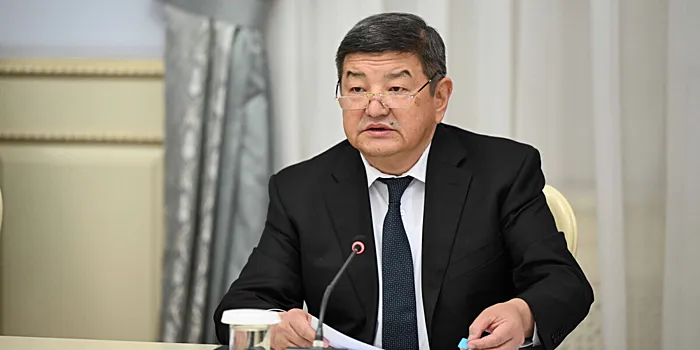
According to Japarov, nothing in nature is created and nothing disappears: the atmosphere, air currents, humidity, glaciers, and precipitation constitute a single, interconnected system, and any large-scale intervention in it can have consequences far beyond the borders of a single country.
It should be noted that Kazakhstan is implementing the project jointly with the UAE National Meteorological Centre.
Gamal Soronkulov, environmental expert:
As a practicing ecologist, I believe that this issue should have been discussed with neighbors. Perhaps this issue could have been discussed at an environmental summit or meetings.
We have a project specifically on water resources and climate change, and a few days ago, during a presentation in the south, I said I was pleased that intergovernmental meetings on water resources have been held recently at various levels, with the parties reaching agreements and jointly addressing issues. And today I heard the news about artificial rain…
It felt like a secret card had been pulled. That’s exactly what happened—without consultation, not very tactfully, one might even say, unseemly, neither neighborly nor gentlemanly. Both the biblical and Quranic precepts of “do no harm” were definitely violated.
Negotiations may be in the offing, but it’s a shame that our closest neighbor has taken such a step. This violation of balance and the principle of equilibrium could lead to confrontation, as we are already outraged and dissatisfied with the violation of the principle of good neighborliness.
Let’s hope the lit fuse doesn’t turn into a fuse and cause an explosion. Because the closer Kazakhstan gets to our mountains with its experiment, the more it could literally affect our glaciers.
— Did Kazakhstan have to agree to this step? Perhaps the issue is regulated by some international agreements?
“The negotiations should have been held at the highest level. Furthermore, there is an Interdepartmental Commission on Water Resources of the Central Asian Countries. At least at that level, they should have gathered, met, and discussed everything.”
Rysbek Satylkanov, head of the Tien Shan High Mountain Scientific Center at the National Academy of Sciences of the Kyrgyz Republic:
“I fully share and support Akylbek Japarov’s opinion; he said everything correctly; I have nothing more to add.”
Kochkunbek Bakirov, acting Head of the Geography Department of the Institute of Geology named after M. Adyshev NAS KR, Candidate of Geographical Sciences:
— Kochkunbek Bakirovich, Kazakhstan began the full-scale launch of its rain-inducing system on May 17, 2026. The project is being implemented jointly with the UAE National Meteorological Center. What risks do such experiments pose for Kyrgyzstan?
“We need to study and calculate everything, because if Kazakhstan actively influences the clouds, for example, in Dzhambul, then we might not get any precipitation.”
— What are the benefits of artificially inducing precipitation under favorable conditions?
— The use of artificial precipitation enhancement technology, according to Russian scientists, allows for an increase in seasonal precipitation in the affected area by 15–30 percent, which has been confirmed by operational work across large areas in Russia, Belarus, Mongolia, Iran, Syria, and Cuba.
— Have any studies been carried out to artificially induce precipitation in Central Asia, and in Kyrgyzstan in particular?
— It should be noted that work on artificially increasing atmospheric precipitation in the regions of Central Asia has a long history.
In the 1980s and 1990s, the Central Aerological Observatory (CAO), together with the Central Asian Regional Scientific Research Institute (SARNIGMI), conducted research into the possibility of obtaining additional precipitation through active influence on clouds in the Karshi steppe of the Uzbek SSR.
In Kyrgyzstan, Russian scientists conducted research in the Naryn River basin to replenish the Toktogul reservoir for irrigation and hydropower purposes.
Several experiments aimed at stabilizing the lake’s level were also conducted at Issyk-Kul. Unfortunately, with the collapse of the USSR, the work, which had barely begun, was halted.
— What are the pressing water resource issues in the Central Asian region?
The construction of the Kosh-Tepa (or Kush-Tepa) Canal in Afghanistan —a large-scale irrigation megaproject—is causing serious concern and discontent in Uzbekistan, as well as another downstream country, Turkmenistan, due to the threat of water shortages. Afghanistan has the right to take water, because there are no agreements between the countries on rational water allocation.
— If one of the countries in the region plans such experiments, should it coordinate this with neighboring states?
— Yes, there must be a legal aspect to the issue. For example, Kazakhstan considers the Chu River a transboundary river and is entitled to some of its water. Uzbekistan and Kazakhstan also consider the Syr Darya River a transboundary river and, therefore, according to the old water allocation system, preserved from Soviet times, they take most of its flow.
If, for example, such research were to be conducted on Issyk-Kul and precipitation were to be caused, then this is still a closed internal basin, and there would be no impact on neighboring Kazakhstan, so disagreements should not arise.
— How should the problem of rational use of water resources be solved?
The construction of the Kambarata-1 Hydroelectric Power Plant also caused discontent and concern among our closest neighbors. During the Karimov era (during the presidency of Islam Karimov – editor’s note), the situation threatened to escalate into a serious conflict between Kyrgyzstan and Uzbekistan. But meetings and negotiations were held, the parties discussed the issue, and now a solution has been found that satisfies everyone.
Kyrgyzstan, Kazakhstan, and Uzbekistan are currently jointly constructing the Kambarata-1 Hydroelectric Power Plant (HPP) on the Naryn River. This project will be the largest hydroelectric power plant in Central Asia, with a capacity of 1,860 MW, and will be crucial for the region’s water and energy balance.
— How are such issues currently regulated between the countries of Central Asia?
— Are you referring to the Interstate Commission for Water Coordination of Central Asia, established in 1992 to manage, rationally use, and protect the water resources of transboundary rivers in the region?
Kyrgyzstan is the only country in Central Asia with its own water resources, which are generated entirely within its territory, and it supplies water to all neighboring countries, including China and Tajikistan. The well-being and livelihoods of not only Kyrgyzstan but also its immediate neighbors depend on the filling of Kyrgyzstan’s reservoirs—Toktogul, Ortotokoy, Kirov, and others.
Therefore, when planning such types of work, it is necessary to take into account the interests of all Central Asian countries.
Baktybek Saipbaev, systems analyst, economist and lawyer:

It’s difficult for me to answer your question, since there were no similar projects in our region, there is no data, and it’s difficult to say what this will lead to.
There are a large number of specialists: meteorologists, glaciologists, climatologists, seismologists, who, in theory, study the environmental situation in a given region of the planet based on years of research. In theory, we should have such people too, who could, for example, say, “at a certain time of year, air masses moved from north to south or from west to east…”
Global climate imbalance is currently underway due to global warming, and this is a separate issue. Scientists are divided over how much this is related to human activity. Some cite greenhouse gases, recommending reducing methane emissions by reducing cow herds—that’s one extreme.
Their opponents counter with the argument that a volcano erupts and releases far more methane than all existing cows combined. And so they, as they say, “butt heads” over this issue. But the fact that humans can greatly influence the climate of a given region is, of course, undeniable.
For example, in many places, humans have drained peat bogs, which are one of the most important natural ecosystems. They provided moisture to the area and supported the growth of various plant, animal, and insect species. When humans began actively draining peat bogs, the outcome was disastrous—fires began to break out, and they are difficult to extinguish because the peat smolders underground for months.
At the same time, plant composition changes dramatically, and entire food chains are profoundly altered, often degrading and disappearing. And people realized this, albeit too late.
Another classic example: humanity is constantly cutting down forests. And this deforestation and so-called desertification are occupying an ever-increasing area every year. In both cases, humans are to blame.
Everyone has somehow forgotten about the unprecedented environmental disaster in the Central Asian region, when the Aral Sea dried up thanks to the relentless economic activity of our neighbors.
So, there are many problems: global warming, glacier degradation, which is observed worldwide—in Tibet, the Andes, and the Alps—but in our republic, specifically, accelerated melting is occurring. Again, no one can tell you exactly by how much, but at least 30 percent. Some say even higher figures.
The fact is that after the collapse of the USSR, we stopped monitoring glaciers, which had been going on since the 1930s. And then it was “everyone’s off to the woods, everyone’s off to the woods”: no one knows what’s happening to them now, what will happen next, how they’re doing—but glacial degradation is happening.
So, returning to this general climate imbalance, we now see all the time that suddenly there is a massive invasion of northern Arctic air masses into the south, then snow falls in the Sahara and, conversely, in the north, some flowers suddenly start blooming unexpectedly early or cloudberries turn green in the tundra… When did this ever happen?
And this is a global problem—a general ecological imbalance, a general disruption of traditional climate zones and belts. And guessing at the tea leaves of artificial rainfall technology…
Yes, of course, from a general theoretical perspective, if the Kazakhs were to cause rain specifically over Turkestan, then one could, of course, assume that it might not reach us. But in response, Kazakhstan might say: who told you that all these rain clouds were coming from us, or maybe the other way around, or maybe it’s Siberia, or maybe from the north?
But we know that during the conflict in the Middle East, Iran started bombing everything in sight, including rain-making installations in the UAE. And now the Iranians are saying: we’ve had a drought for years, and now it’s raining.
So, indirectly, we can say that rain-making technology apparently has an effect, but it’s impossible to prove right now. I don’t approve of what the Kazakhs have come up with, but we can’t stop them. The response would be: who proved it was your clouds? Especially since Kazakhstan is 2,800,000 square kilometers.
Therefore, how the winds blow there, which way they blow, where they blow from – this needs to be sorted out.
As for what Mr. Japarov did… In general, I certainly support his thinking, but everything needs to be backed up with calculations, forecasts, and other evidence. Unfortunately, Kyrgyzstan can’t contribute anything from that. Nothing.
Legal side of the issue:
Edil Marlis uulu, public figure:
Currently, there is no single comprehensive treaty under the auspices of the UN that would regulate in detail the civilian use of artificial precipitation technologies (cloud seeding), but this activity is regulated by a number of international acts that relate to environmental safety.
The 1976 ENMOD Convention states that the use of weather modification techniques for peaceful purposes is permitted. For example, it is permitted for agriculture or drought control, as long as it does not cause harm to other countries.
The World Meteorological Organization (WMO) is urging countries to notify their neighbors in advance of large-scale projects, as “rain theft” —cloud seeding that deprives downwind areas of precipitation—can cause cross-border conflicts.
In addition to specific conventions, general environmental standards apply to rainmaking, such as the “no harm” principle: a state is obliged to ensure that activities within its territory do not cause environmental damage to its neighbors.
International law faces grey areas in this matter, as it is difficult to prove that a drought in one country is caused by a neighboring country having previously squeezed out all the clouds.
International law does not clearly define who owns atmospheric resources. While there are no direct prohibitions on peaceful rainmaking, any such activity must comply with good-neighborly norms and not violate the ENMOD Convention.
REFERENCE Reporter . kg : The ENMOD Convention ( Environmental Modification Convention ) is an international UN treaty prohibiting the military or any other hostile use of environmental modification techniques. It was signed in 1976 and entered into force in 1978.
According to the document, parties to the convention are prohibited from using environmental modification technologies that are destructive, large-scale, or long-term:
— initiation of earthquakes, tsunamis or destruction of the seismic balance of regions;
— intervention in hydrological systems: causing floods, changing river beds;
— artificial change of climate and weather conditions: causing artificial precipitation, dispersing clouds to create drought;
– impact on the ozone layer or the Earth’s ionosphere.
If a project may affect the interests of other countries, it is recommended that prior consultations be held within the WMO .
A look through the lens of security
Taalaibek Dzhumadylov, a veteran of the special services and an expert on national security issues:

Artificial impact on the environment requires scientific study and research, as all these practices are dual-use technologies and can be used not only to induce artificial rain, but also as a climate weapon.
We are members of the CSTO, whose charter includes the concept of “collective security.” This means that any member of the organization, when taking measures to strengthen its security, must not act to the detriment of the security interests of other members. In other words, collective security must be indivisible and integral.
In connection with the development of various types of weapons—climate, seismic, biological, chemical—this issue requires careful study and regulation, since it is unknown what negative consequences this may cause in these countries.
Given the severity of our water and energy problems, this could result in a transboundary threat, and the CSTO should also address this issue.
Let me remind you: one of the claims Iran made against the Emirates was the accusation that the UAE used rain-inducing technology, which resulted in a drought in Iran.
There’s currently a conspiracy theory that the Emirates’ artificial rain-making technology led to the floods in Dagestan, and this too requires investigation. The fact is that in any system, individual elements are interconnected and interact, and an imbalance can lead to unpredictable consequences elsewhere.
And it remains to be seen how the experiments in Turkestan will affect traditional air mass movements. At one time, the reckless and excessive use of water resources in the Syr Darya and Amu Darya rivers led to the drying up of the Aral Sea, which, in turn, led to sandstorms and salt storms, and subsequently to the melting of glaciers.
We live in a single ecosystem of Central Asia, and such things require careful study, scientific research, using many years of observation and experience.
Anara Mamytova .
Google machine translated